
If you are trying to rent, buy, or manage a 3-bedroom unit through the Section 8 Housing Choice Voucher Program, one of the first questions that comes up is simple: how much does Section 8 pay for a 3-bedroom home?
That question matters because a 3-bedroom unit is often in high demand. Families need the extra space. Parents need room for children. Extended families may live together. Sometimes a tenant may need a spare room for caregiving or medical reasons. Because of that demand, 3-bedroom units are often harder to find and more expensive than smaller homes.
The short answer is that Section 8 does not pay the same amount everywhere. The payment depends on where the home is located, how much the household earns, the local rent market, the housing authority rules, and the utility setup. In one city, the voucher may cover around $1,200 for a 3-bedroom unit. In another, it may cover $2,500 or more. In very expensive areas, the amount can be even higher.
If you are a housing professional or investor, you want a clear picture of how Section 8 payments are calculated.
What Is Section 8 Housing?
Overview of the Housing Choice Voucher Program
Section 8 is the common name for the Housing Choice Voucher Program. It is a federal housing assistance program run by the U.S. Department of Housing and Urban Development, or HUD.
The main goal of the program is to help low-income families, seniors, and eligible individuals afford decent housing in the private market. Instead of living only in public housing, participants can choose homes, apartments, or townhomes from landlords who accept vouchers.
This gives families more freedom. They are not limited to a single type of building or neighborhood. They can look for housing that fits their family size, school needs, work commute, and safety concerns.
How Section 8 works for rent payments
Section 8 does not usually cover the full rent on its own. The tenant still pays part of the rent, and the voucher covers the rest.
In most cases, the tenant pays around 30% of adjusted monthly income toward rent and utilities. The housing authority then pays the landlord the remaining approved amount, up to the voucher limit.
This means Section 8 is not a flat rent payment program. It is a shared-cost system. The tenant pays a portion based on income, while the subsidy fills in the rest.
For example, if a family earns less, they may pay less. If they earn more under the program’s rules, their share may be higher. But the payment must still fit within local standards.
Role of Fair Market Rent
A very important term in Section 8 is Fair Market Rent, often called FMR.
FMR is a rent estimate set by HUD for different bedroom sizes in each region. It helps housing authorities decide the general range for voucher payments. A 3-bedroom unit in a low-cost rural area will have a different FMR than a 3-bedroom unit in New York city or Los Angeles.
This matters because the voucher amount is tied to the local market. If rent prices are high where you live, the Section 8 payment standard is usually higher too. If rent prices are low, the payment standard will usually be lower.
So when people ask how much Section 8 pays for 3 bedroom housing, the first thing to remember is this: the answer depends heavily on local market rent.
How Section 8 Calculates Payment for a 3 Bedroom Unit
Payment standard explained
The payment standard is the maximum amount a housing authority is willing to subsidize for a unit of a certain size. It is based on the local rental market and the number of bedrooms.
For a 3-bedroom unit, the payment standard is usually higher than for a 1- or 2-bedroom unit because larger homes cost more to rent. But the exact number depends on the housing authority responsible for the area.
The payment standard is not always the same as the rent the landlord asks for. It is a guideline for determining the subsidy amount.
Utility allowances
Utilities can also affect the final payment amount.
Some rentals include utilities like water, gas, or electricity in the rent. Others do not. If the tenant must pay utilities separately, the housing authority may provide a utility allowance to help balance the cost.
This matters because the voucher is meant to cover housing costs fairly. If utility costs are high, the tenant’s out-of-pocket cost may change. If utilities are included, the rent calculation may be simpler.
Income-based contribution rule
Most Section 8 tenants pay a share of the rent based on their income. The general rule is that a household pays about 30% of adjusted income toward housing expenses.
That amount is then compared with the unit’s rent and utility structure. The voucher pays the rest, but only up to the approved local limit.
So if a household’s income is low, the tenant portion is lower. If the household earns more, the tenant portion may increase.
Fair Market Rent vs payment standard
These two terms are related but not identical.
- Fair Market Rent (FMR) is HUD’s estimated market rent for a unit in a specific area.
- The payment standard is the amount the local housing authority uses to calculate voucher assistance.
In many places, the payment standard is close to FMR. But it may be slightly above or below it depending on local policy.
That is why Section 8 payments can vary so much from place to place. A 3-bedroom unit in one city might be treated very differently from the same-sized unit in another city.
How Much Does Section 8 Pay for a 3 Bedroom Unit?
National average payment range
Now let’s get to the main question: how much does Section 8 pay for 3-bedroom housing?
A realistic national range is often around $1,200 to $2,500+ per month, but that is only a broad estimate. Some areas are below that, and some are well above it.
Why such a wide range? Because rent prices in the United States vary by location. A modest 3-bedroom house in a small town may rent for much less than a 3-bedroom apartment in a major city. Section 8 usually follows that local pattern.
So the answer is not one number. It is a range based on geography, income, and local rent levels.
Low-cost areas: rural and small cities
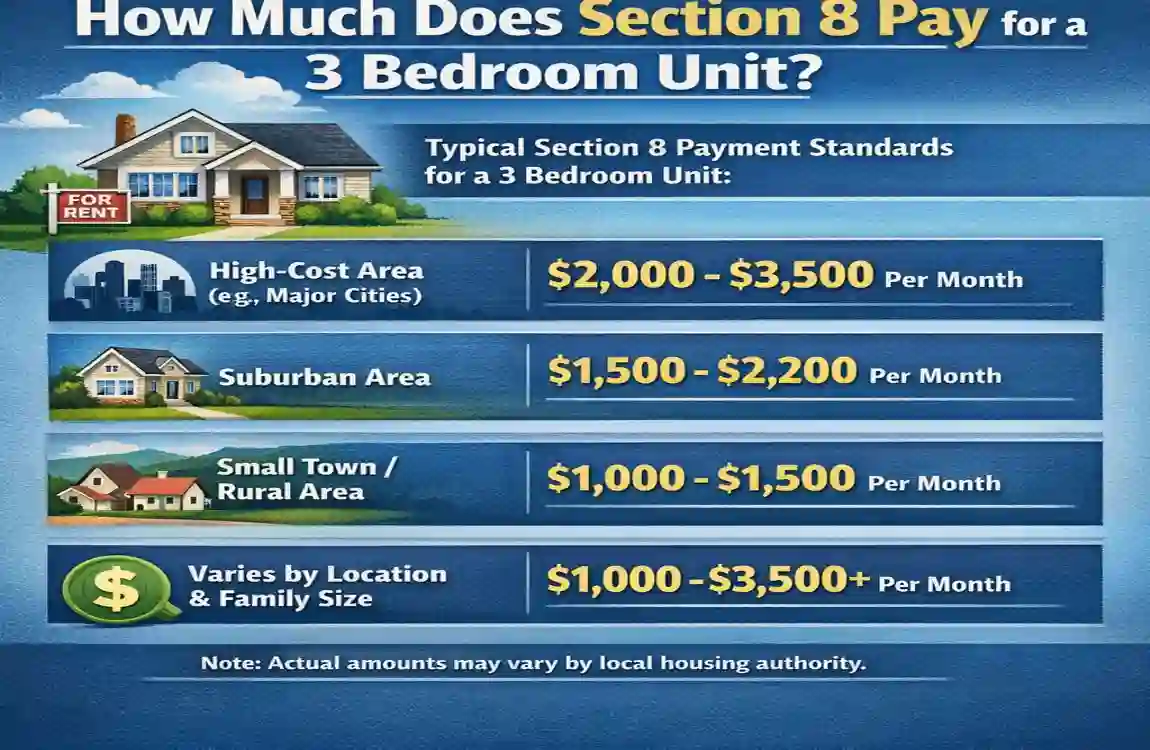
In low-cost areas, such as some rural communities or smaller cities, the 3-bedroom Section 8 payment may fall around $1,000 to $1,500 per month.
These areas usually have:
- Lower average rent
- Lower property values
- Less competition for housing
- Smaller local payment standards
In these places, the voucher amount may be enough to cover a basic family home or apartment. Still, it may not stretch as far if the unit is newly renovated or includes many utilities.
Mid-cost areas: suburban regions
In suburban areas or moderate-cost cities, the amount is often around $1,500 to $2,200 per month.
These regions usually have a balanced housing market. They are not as expensive as major metro areas, but they are not especially cheap either. A 3-bedroom unit in a suburban area may be a townhouse, duplex, apartment, or single-family rental.
This is the range many people see when they ask how much Section 8 pays for 3-bedroom homes in average markets.
High-cost areas: major cities
In major cities and expensive housing markets, the Section 8 payment for a 3-bedroom unit can rise to $2,200 to $3,500+ per month.
Cities like New York, Los Angeles, San Francisco, Boston, Seattle, and parts of New Jersey often have much higher payment standards because the rent itself is higher. The local housing authority must account for those conditions if they want families to find housing in the private market.
This is also where voucher holders often face the most frustration, because rent can rise faster than available voucher limits.
Example calculation scenario
Let’s look at a simple example.
Suppose a household has an adjusted monthly income of $2,000.
If the tenant’s portion is around 30%, then the tenant would pay about $600 toward housing.
Now imagine the approved rent for a 3-bedroom unit is $1,800.
In that case, the voucher might cover about:
$1,800 – $600 = $1,200
So the Section 8 program would pay around $1,200, and the tenant would pay around $600, assuming the rent fits within the payment standard and the utility arrangement works out.
That is a simplified example, but it clearly shows the basic idea.
Key factors that affect payment amount
Several things can change the final number:
- Location
- Household income
- Family size
- Local housing authority rules
- Utility costs
- Whether rent is above or below the payment standard
When you ask how much Section 8 pays for 3-bedroom units, these are the details that matter most.
Quick payment range table
Area Type Typical 3-Bedroom Section 8 Payment
Rural / Low-cost area $1,000–$1,500
Mid-cost suburban area $1,500–$2,200
High-cost city $2,200–$3,500+
This table is just a guide. Your actual local amount may be higher or lower.
Factors That Influence Section 8 3 Bedroom Payments
Geographic location
Location is the biggest factor in Section 8 rent support. A voucher in one county may cover much more or much less than in another because rent levels differ.
For example, the same 3-bedroom home may rent for much more in a large city than in a small town. Section 8 payment standards try to match local rental reality.
Household income level
The tenant’s income directly affects how much of the rent they must pay.
A household with lower income generally pays less out of pocket. A household with higher income may pay more. That means the voucher pays less if the tenant can contribute more.
This is why two families renting the same 3-bedroom unit may still have different out-of-pocket costs.
Housing authority policies
Each Public Housing Authority (PHA) can set its own rules within HUD guidelines. That means payment standards can differ even between nearby areas.
Two counties in the same state may have different voucher amounts because each authority adjusts its standards based on the local market.
This is one reason there is no single answer to how much Section 8 pays for 3-bedroom properties nationwide.
Market rent conditions
If rent goes up in a city, Section 8 payment standards may also rise over time. If the market slows, the payment standard may remain flat or change more slowly.
Inflation, housing shortages, and strong rental demand can all push housing assistance amounts upward.
Unit condition and amenities
A clean, well-kept 3-bedroom unit may be more attractive to both tenants and housing authorities. However, the rent still must be reasonable for the area.
Amenities such as:
- New appliances
- Updated flooring
- Central air
- Extra bathrooms
- Parking
- Washer/dryer hookups
Can all support a higher asking rent, but only if the market justifies it.
Section 8 Payment Standards for 3 Bedroom Units
Payment standard vs actual rent
This is one of the most important ideas to understand.
The payment standard is the voucher limit, but the actual rent is what the landlord asks for. These two numbers are not always the same.
If the asking rent is below the standard, the voucher may cover a larger share of the unit’s cost. If the asking rent is higher, the tenant may need to pay the difference, depending on local rules and affordability.
Rent reasonableness test
HUD requires a rent reasonableness test to make sure the rent is fair compared with similar units in the area.
This means the housing authority checks whether the landlord’s price is reasonable for a 3-bedroom unit with similar size, location, and condition. The goal is to avoid overpaying for a unit that does not match the market.
Maximum allowable rent rule
A voucher cannot simply pay any amount the landlord wants. The rent must remain within the approved limits set by the local housing authority and HUD rules.
If the rent is too high, the unit may not qualify unless the tenant can legally cover the difference and the authority allows it.
Why bedroom size matters
A 3-bedroom unit often has a higher subsidy limit because it is meant for larger households. More bedrooms usually mean more space, more rent, and often more utility costs.
That is why Section 8 uses separate payment standards for different bedroom sizes. A 3-bedroom home is not treated the same as a 1-bedroom apartment.
How Tenants Can Estimate Their Section 8 Housing Benefit
Using income-based calculation
A simple starting point is the 30% rule. In many cases, tenants pay about 30% of their adjusted monthly income.
Here is the basic idea:
- Find your adjusted household income
- Multiply it by 30%
- Compare that amount to the rent and utility setup
If the housing authority approves the unit and the rent fits the payment standard, the voucher covers the remaining amount.
Checking local PHA payment standards
The best way to estimate your actual benefit is to check your local Public Housing Authority’s website.
They often publish:
- Bedroom-based payment standards
- Utility allowance charts
- Income rules
- Voucher limits
- Waiting list information
This is the most reliable source because it reflects your specific location.
Estimating utility costs
Do not forget utilities. If you must pay for heat, electricity, gas, or water out of pocket, those costs affect your total housing budget.
A unit with lower rent but high utility costs may actually be more expensive than a slightly higher-rent unit with utilities included.
Using online rent estimators
Online tools can help you get a rough idea of local rent values and voucher standards. HUD tools and housing calculators may give you a starting point, but they should not replace official PHA information.
Use them as a guide, not the final answer.
Tips for Finding a 3 Bedroom Unit Under Section 8
Work with local housing authorities
Housing authorities often know which landlords accept vouchers and which properties are already approved or commonly used by voucher holders.
This can save you a lot of time. Ask for updated listings and contact information if available.
Search in high-approval areas.
Some landlords are more familiar with Section 8 and more willing to work with voucher tenants. These areas may have better chances of approval and faster processing.
Act quickly on listings.
Three-bedroom units are in high demand. If you find one that fits your budget and voucher limit, do not wait too long. Good units can disappear fast.
Check property requirements
Even if a unit fits the budget, it must still pass inspection—Housing Quality Standards matter. The home must be safe, clean, and in decent condition.
Expand your search radius.
If your first area is too expensive or has too few listings, look at nearby towns or counties. Sometimes a small move can open up many more options.
Here are a few smart search habits:
- Check PHA listings often
- Call landlords directly
- Ask about voucher acceptance up front
- Review the rent limit before touring
- Keep documents ready for faster approval
Common Challenges With Section 8 3 Bedroom
Units
 Limited availability
3-bedroom units are usually harder to find than smaller units. Larger homes are more expensive, and there are fewer of them on the market.
This creates a supply problem. Many families need them, but not enough are available.
Landlord participation issues
Not every landlord wants to accept Section 8 tenants. Some are unfamiliar with the program. Others worry about paperwork, inspection delays, or payment timing.
That can make your search more difficult, even if the voucher amount is enough.
Inspection delays
Section 8 housing must meet safety standards before approval. That inspection process can take time, especially if repairs are needed.
Even a good unit may be delayed if it needs small fixes before it can pass.
Rent limit restrictions
Sometimes the unit is available, but the rent is too high for the voucher. In that case, the household may need to keep searching or see if the difference is manageable under local rules.
Frequently Asked Questions
How much does Section 8 pay for a 3-bedroom unit on average?
On average, Section 8 may pay $1,200 to $2,500+ per month for a 3-bedroom unit. The exact amount depends on the local market, the housing authority, the tenant’s income, and the utility setup.
Does Section 8 pay the full rent for a 3-bedroom3-bedroom house?
Usually, no. The tenant typically pays a portion of the rent, often around 30% of adjusted income, and Section 8 pays the remainder up to the approved limit.
Can Section 8 pay more in expensive cities?
Yes. In expensive cities, voucher payment standards are usually higher because local rents are higher. That is why the amount in places like New York or San Francisco is often much larger than in rural areas.
What if rent is higher than the voucher amount?
If the rent exceeds the voucher limit, the tenant may need to pay the difference, provided local rules allow it and the unit still passes the rent reasonableness test. In some cases, the unit may not qualify at all.
Who decides the payment amount?
The local Public Housing Authority decides the payment standard based on HUD rules and the local housing market. HUD sets the framework, but the PHA handles the local numbers.
Can two families get different amounts for the same 3-bedroom unit?
Yes. If their incomes differ, their tenant contributions may differ. One family may pay more out of pocket than another, even in the same unit.
Where can I find my local payment standard?
Check your local PHA website or contact the housing authority directly. They usually publish bedroom-based payment standards and utility allowances.
| Factor | Details |
|---|---|
| Program | Section 8 Housing Choice Voucher |
| Unit Size | 3 Bedroom |
| Typical Payment Basis | Fair Market Rent (FMR) set by HUD |
| Average U.S. Range | ~$1,200 to $2,500+ per month (varies by location) |
| Tenant Contribution | Usually ~30% of adjusted monthly income |
| Housing Authority Pays | Remaining portion up to payment standard |
| High-cost areas | Can exceed $3,000/month in cities like NYC or SF |
| Low-cost areas | May be closer to $900–$1,400/month |
