
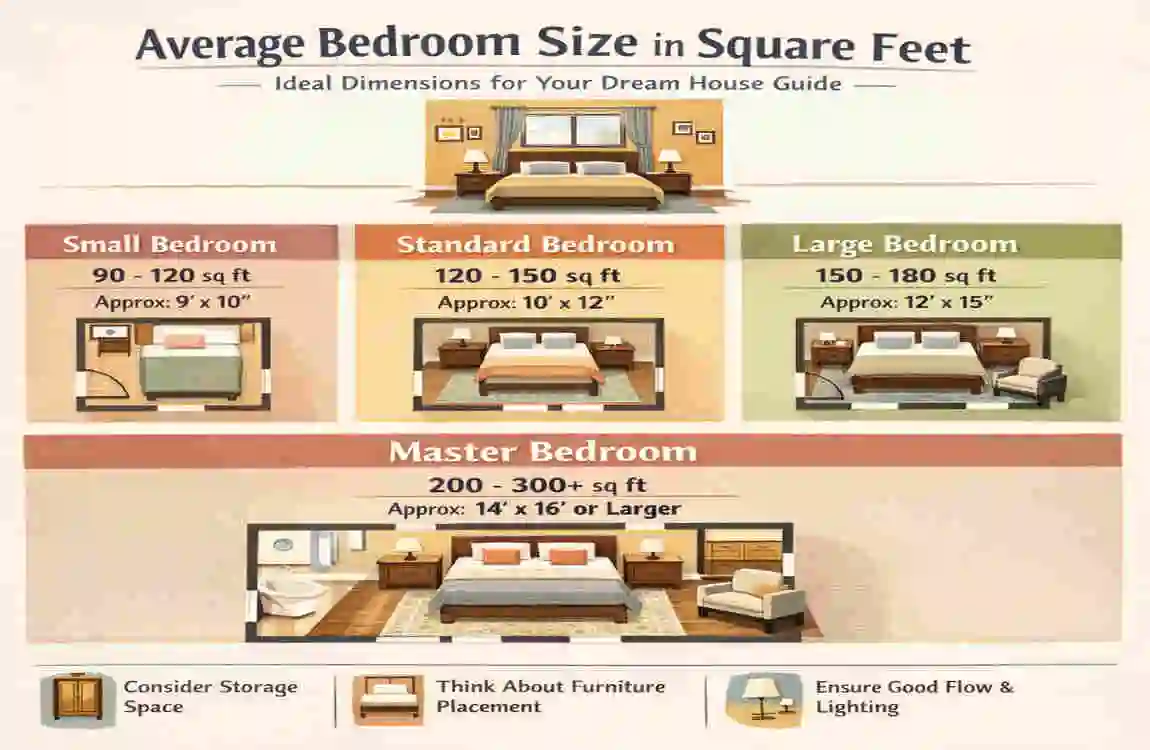
Have you ever found yourself staring at a blank floor plan, sketching out boxes on a piece of graph paper, and wondering, ” How many square feet is an average bedroom when planning your dream house? If you are currently in the exciting but overwhelming phase of designing a new home or planning a major renovation, you are certainly not alone. Getting the dimensions right is one of the most critical steps in the entire architectural process.
When you build or buy a house, the bedrooms are your ultimate sanctuaries. They are the spaces where you start and end your day. If you make them too small, you will feel cramped and frustrated every time you try to open a dresser drawer. If you make them too large without a clear purpose, you might waste valuable budget and square footage that could have been better used in your living room or kitchen.
So, let us answer your burning question right away: standard bedrooms typically range from 120 to 200 square feet. Meanwhile, expansive master suites usually start around 200 square feet and can easily reach 300 square feet or more in luxury builds.
| Bedroom Type | Average Sq Ft | Common Dimensions (ft) | Notes |
|---|---|---|---|
| Small/Guest | 100 | 10×10 | Fits twin/full bed; minimum legal often 70 sq ft. |
| Standard | 132 | 11×12 or 10×13 | Ideal for queen bed + nightstands. |
| Child’s Room | 120 | 10×12 | Extra play space recommended. |
| Master/Primary | 224 | 14×16 | Includes ensuite potential; 200-300 sq ft range. |
| Luxury Master | 300+ | 15×20 | For spacious homes with walk-ins. |
Standard Bedroom Sizes Explained
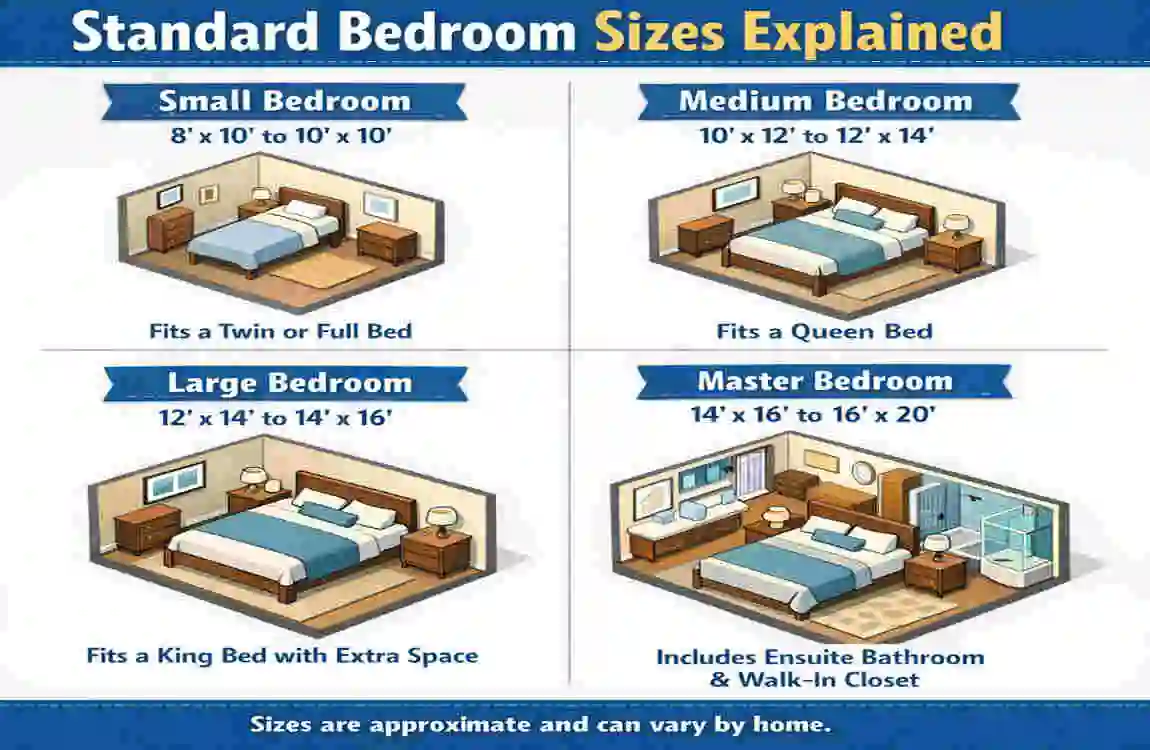
When you sit down with an architect or a builder, the word “average” gets thrown around a lot. But what does that actually mean for your daily life? If you are trying to figure out how many square feet an average bedroom is, you need to look at both national averages and local building codes.
In the United States, the standard secondary bedroom (think guest rooms or children’s rooms) typically measures around 132 square feet. In practical terms, this usually translates to a room that is 10 feet by 13 feet. This size provides just enough space for a comfortable bed, a standard nightstand, and a moderately sized dresser, while still leaving enough room for a walking path.
However, bedroom square footage varies wildly depending on where you are in the world. In the U.S., you will generally see secondary bedrooms ranging from 120 to 150 square feet. If you travel over to Europe, space is often at a Premium, and the average room drops closer to 100 square feet. On the flip side, luxury custom homes will often feature secondary bedrooms that mimic the size of standard master suites.
To help you visualise how these spaces break down, let us look at the differences between secondary rooms and master suites.
Bedroom Dimension Breakdown
Bedroom Type Average Sq Ft Typical Dimensions (ft)Best Suited For
Child/Guest Room 120 sq ft 10 x 12 Basic setups, twin/full beds, single occupants
Standard Bedroom 132 sq ft 10 x 13 Couples, older teenagers, queen beds
Master Suite 250+ sq ft 14 x 18 Growing families, king beds, sitting areas
Key Factors Influencing Size
Several factors determine why a builder might choose to make a room 120 square feet rather than 150 square feet.
- Family Size: Larger families often need more bedrooms, which can mean sacrificing the square footage of each room to fit them all within the house’s footprint.
- Location: Urban environments with high land costs will naturally dictate smaller, more efficient bedroom designs.
- House Style: A sprawling single-story ranch has a much different spatial flow than a narrow, three-story townhome.
Expert Tip for Homeowners: Did you know that a room must meet strict legal requirements to officially be listed as a bedroom on the real estate market? According to most building codes, a room must be at least 70 square feet to be legally considered a bedroom. It must also have a ceiling height of at least 7 feet, a means of egress (like a large enough window to escape through in a fire), and a source of natural ventilation.
Ideal Dimensions for Modern Dream Houses
Knowing the bare minimums and the statistical averages is great. Still, you aren’t building just any house—you are building your dream house. So, how many square feet is an average bedroom when maximum comfort is your top priority?
For optimal, breathable comfort, aim for 150 to 200 square feet in your secondary rooms. At this size, you can easily accommodate a plush queen-size bed, two matching nightstands, a large dresser, and still have a generous walkway without feeling like you are navigating an obstacle course in the dark.
Navigating Bedroom Trends
The way we use our bedrooms has fundamentally changed in recent years. Moving into 2026, the trend is shifting heavily toward open-concept suites and multifunctional spaces. A bedroom is no longer just a place to close your eyes. For many, it doubles as a quiet home office, an intimate yoga studio, or a cosy reading lounge. If you plan to incorporate a desk or seating area, you need to push that square footage closer to 200 square feet.
Choosing Dimensions by House Type
The perfect size also depends heavily on the type of house you are constructing:
- Starter Homes: If you are building a smaller, budget-friendly starter home, keeping secondary bedrooms around 100-120 square feet is completely acceptable and highly efficient.
- Forever Family Houses: If this is the home you plan to raise your kids in for the next twenty years, you will want to aim for 150+ square feet. Teenagers need space for desks, larger beds, and hanging out with friends.
The Bed Size Calculation Guide
Before you finalise your blueprints, you need to work backwards from your furniture. Here is a quick calculation guide:
- A Twin bed fits well in a 70- to 90-square-foot room.
- A Full or Queen bed requires at least 100 to 120 square feet to allow for walking space.
- A King-size bed is massive. To comfortably fit a king bed alongside other standard furniture, your room needs to be at least 15×15 feet (225 square feet).
Pros and Cons of Different Bedroom Sizes
Smaller Bedrooms (Under 120 sq ft)
- Pros: Highly affordable to build, cheaper to heat and cool, and naturally creates a very cosy, intimate atmosphere.
- Cons: They can feel cramped quickly, limit your furniture options, and lack space for activities other than sleeping.
Larger Bedrooms (200+ sq ft)
- Pros: Incredibly luxurious, offer space for home offices or sitting areas, and allow for massive beds and grand furniture.
- Cons: Higher construction costs, more expensive utility bills, and they can feel cold or empty if not styled correctly.
The Business Angle: When our architectural team designs a custom home, we obsess over optimising space. We know that hitting that sweet spot of 130 to 150 square feet for secondary bedrooms maximises your future resale value without unnecessarily inflating your immediate construction budget.
Factors Influencing Bedroom Square Footage
When you ask, “How many square feet is an average bedroom?” you also need to ask why the average is what it is. You cannot just draw a giant square on a piece of paper and call it a day. Several external factors will actively dictate the size and shape of your rooms.
Strict Building Codes
We touched on the 70-square-foot minimum, but building codes go much deeper than that. Local municipalities have strict rules that influence design. For instance, most codes require standard interior doors to be at least 32 to 36 inches wide to accommodate moving furniture (and to remain accessible). Furthermore, ceilings typically must be at least 7 feet high over the majority of the floor area. If you are building a bedroom in a converted attic with sloped ceilings, your usable, legal square footage might be drastically reduced.
Your Unique Lifestyle Needs
Your daily life should dictate your floor plan, not the other way around.
- Growing Children: Kids do not just sleep in their rooms; they play in them. If you have toddlers, adding an extra 50 square feet of floor space for toy storage and playmats is a game-changer.
- Remote Work: If you work from home and need to put a desk in your bedroom, you need to account for the desk, the chair clearance, and the visual background. A remote work setup demands a room of 200+ square feet to keep your sleeping area feeling separate from your workspace.
The Impact on Resale Value
You might plan to live in this house forever, but it is always wise to think about resale value. Real estate data shows a direct correlation between bedroom size and buyer interest. Homes with secondary bedrooms of 150+ square feet tend to sell 10% to 15% faster than homes with cramped 100-square-foot rooms. Buyers want space, and they are willing to pay a Premium for a standard bedroom-size house that feels expansive.
Budget and Construction Costs
Let us talk numbers. Every single square foot you add to a floor plan costs money in materials, labour, and future utilities. Depending on your market, new construction costs can range anywhere from $100 to $200+ per square foot. Adding just 50 square feet to three bedrooms increases your overall floor plan by 150 square feet. That simple change could increase your building budget by $15,000 to $30,000. You have to balance your desire for space with your financial reality.
Current Design Trends to Consider
- Sustainable Materials: Smaller bedrooms are trending among eco-conscious builders because they require fewer materials and less energy to maintain.
- Smart Storage: In compact designs, builders are incorporating wall niches, under-bed storage, and towering vertical closets to make smaller footprints feel twice as functional.
Design Tips to Maximise Your Bedroom Space
Even if you know exactly how many square feet an average bedroom is, you might find yourself stuck with a layout that falls on the smaller side of that average. Perhaps you are renovating an older, historic home, or maybe your budget dictates a tighter floor plan.
Do not panic! You do not need a massive 300-square-foot room to create a stunning, comfortable sanctuary. With clever design tricks, you can make an average-sized room feel incredibly spacious.
Clever Layout Hacks
If your bedroom is hovering under 130 square feet, you need to get creative with your layout. The floor is your most precious commodity, so keep it clear.
- Murphy Beds: These are not the clunky pull-down beds of the past. Modern Murphy beds are stylish and let you reclaim your floor space during the day—perfect for a room that doubles as an office.
- Built-in Cabinetry: Instead of buying a bulky freestanding dresser, have your contractor install built-in shelving and drawers around your closet or bed frame. Built-ins look seamless and take up far less floor space.
The Art of Furniture Scaling
The biggest mistake homeowners make is buying furniture that is far too large for their bedroom square footage. You have to scale your pieces to the room. If you have a 120-square-foot room, a massive, ornate California King bed with a thick wooden sleigh frame is going to swallow the space whole. Instead, opt for a sleek, low-profile Full or Queen bed. Use slender nightstands instead of heavy wooden blocks, and consider mounting your reading lamps on the wall to free up tabletop space.
Prioritising Lighting and Ventilation
A small room feels like a cave when poorly lit. Beyond meeting the legal code requirements for an egress window, you should actively maximise natural light. Use sheer curtains instead of heavy drapes. Hang a large mirror directly opposite the window to bounce natural sunlight around the room, instantly making the space feel twice as large. Ensure your ceiling fan or HVAC vents are positioned perfectly to keep fresh air circulating.
Your Step-by-Step Bedroom Renovation Guide
If you are planning to upgrade your current space to better align with ideal bedroom dimensions, follow this simple process:
- Measure Your Current Space: Grab a tape measure and document your exact dimensions, noting where the doors, windows, and closets sit.
- Sketch Your Ideal Layout: Use a free online room planner or a piece of graph paper to map out where your bed and furniture will go.
- Consult the Professionals: Before you knock down any drywall to expand a room, bring in the experts to check for load-bearing walls and electrical lines.
Ready to transform your space? Contact us today for a free quote on your dream house bedroom upgrades!
Common Mistakes and How to Avoid Them
Even with the best intentions, it is easy to make critical errors when drawing up a floor plan. If you are constantly asking how many square feet an average bedroom is, you might become too focused on the math and lose sight of its practical application. Here are the most common pitfalls to avoid.
Undersizing for Future Needs
It is easy to look at a 100-square-foot room and think, “This is perfect for a nursery!” But babies grow up. Suddenly, that crib becomes a twin bed, then a full bed. Then they need a desk for homework and larger closets for adult-sized clothes. If you undersize a room based on your current needs, you will severely cramp your future lifestyle. Always aim slightly above the average 132 square feet if your budget allows.
Ignoring Local Codes
We cannot stress this enough: do not try to squeeze a “bedroom” into a windowless basement closet to increase your home’s official bedroom count. Ignoring building codes regarding minimum square footage (70 sq ft) and egress windows will not only result in hefty local fines but also createso create a dangerous, unlivable space. Furthermore, a home appraiser will catch it, meaning you won’t get the financial boost of an extra bedroom when you try to sell.
Overlooking the “Flow” of the Room
A room can be as large as 160 square feet. Still, if the door swings directly into the closet, or if the only logical place to put a bed blocks the window, the room will feel terrible to live in. Always consider the flow of traffic.
Pro Tip: Take a roll of painter’s tape and physically outline your proposed bedroom dimensions and furniture layout on the floor of your current home or driveway. Walk through the tape outlines. You will instantly feel if the space is too tight.
Quick List of Pitfalls to Avoid:
- Failing to account for the swing radius of interior and closet doors.
- Forgetting to add enough electrical outlets near the proposed nightstand locations.
- Placing the room’s entrance directly off a noisy space, such as a loud kitchen or a living room TV wall.
- Prioritising floor space while completely forgetting to allocate square footage for a proper closet.
Bedroom Size by House Style Comparison
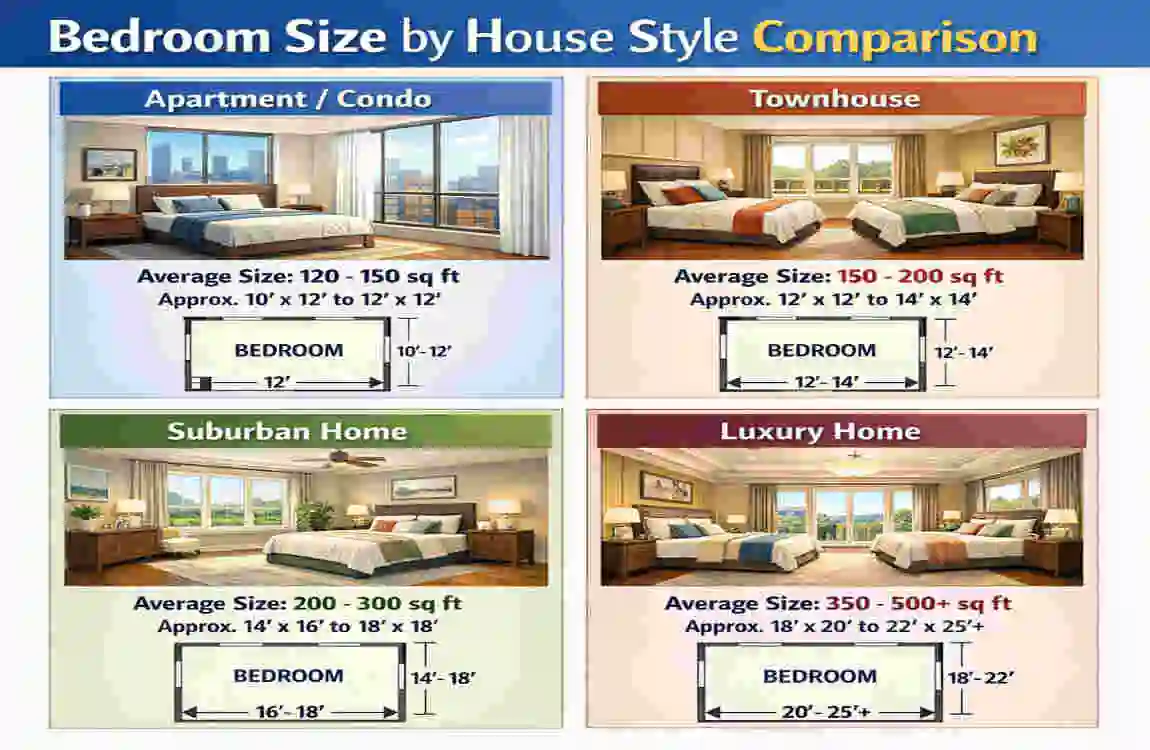
The architectural style of the home you are building will dramatically influence your average bedroom size. Buyers expect different spatial experiences depending on the exterior of the house. You would not expect the same bedroom dimensions in a historic bungalow that you would in a sprawling suburban new-build.
If you are searching for an average bedroom size house based on popular architectural styles, here is a helpful comparison to guide your expectations.
House Architectural Style, Avg Secondary Bedroom Sq Ft, Example Dimensions, Vibe and Layout
Traditional Ranch 140 sq ft 12 x 12 Wider, boxy footprints. Usually clustered together down a single, long hallway.
Compact Two-Story 130 sq ft 10 x 13 Tighter spaces designed to stack vertically. Often feature smaller, standard closets.
Modern Farmhouse 180 sq ft 12 x 15 Expansive, airy designs with high ceilings, large windows, and walk-in closets.
Tying Sizes to Buyer Preferences
Understanding these stylistic differences is crucial if you are building a home with resale in mind. A buyer looking at a sprawling Modern Farmhouse expects luxury. If they walk upstairs and find 110-square-foot bedrooms, they will be deeply disappointed, and it could cost you the sale. Conversely, a buyer looking at a cute, minimalist Two-Story home will be perfectly content with 130-square-foot rooms, as they align with the expected cosycosy aesthetic. Match your square footage to the architectural promise of your home’s exterior!
FAQs: Your Bedroom Sizing Questions Answered
How many square feet is an average bedroom?
In general, a standard secondary bedroom in a modern home is between 120 and 200 square feet. The widely accepted national average is roughly 132 square feet, which translates to a 10-foot-by-13-foot room.
What is the average main bedroom size in square feet?
Because master bedrooms serve as homeowners’ private retreats, they are significantly larger. The average main bedroom size in square feet typically ranges from 200 to over 300. This does not even include the attached walk-in closets or the en-suite main bathroom, which can easily double the suite’s total footprint.
What is the absolute minimum legal size for a bedroom?
According to the International Residential Code (which most local municipalities adopt), a room must have a minimum floor area of 70 square feet to be legally defined as a bedroom. Furthermore, it cannot be less than 7 feet in any horizontal direction (meaning you cannot have a 5×14-foot bowling alley).
How much does it cost to enlarge an existing bedroom?
Expanding an existing bedroom is a major structural renovation. If you are pushing an exterior wall outward to add square footage, you should expect to pay anywhere from $150 to $250+ per square foot. Bumping out a room by just 50 square feet could cost $10,000 to $15,000, including the foundation, roofing, drywall, and electrical work required.
Can I put a King-size bed in a 120-square-foot room?
Technically, a standard King bed (roughly 76 inches wide by 80 inches long) will fit in a 10×12 room. However, it will consume almost the entire floor space. You will have barely any room to walk around the edges, and you likely will not be able to fit a dresser or open your closet doors comfortably. For a King bed, you ideally want a room that is at least 150 to 200 square feet.
