
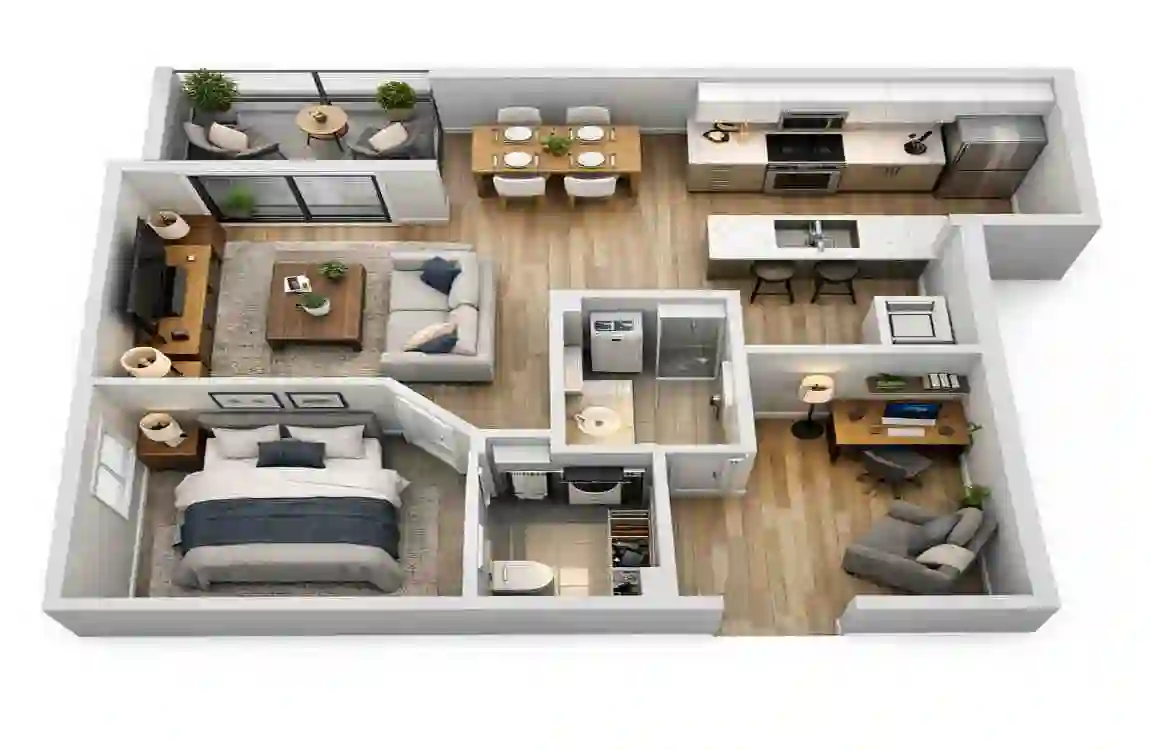
Picture this scenario. You have finally saved up enough money to buy your first property, or you are looking for a fresh rental that suits your remote-working lifestyle. You open your laptop, browse through the latest listings booming housing market, and suddenly, you see a confusing term pop up again and again.
You read the words “1+1 layout” or “1 bed + den” and pause. If you are like most home hunters, you might find yourself scratching your head and asking: What does 1 bedroom plus den mean, exactly? Is it a two-bedroom apartment in disguise? Is it just a glorified storage closet?
If these questions are swirling in your mind, you are absolutely not alone. Navigating the real estate market is challenging enough without having to decode industry jargon. Property listings are sometimes written in a completely different language. But do not worry, because we are here to clear up the confusion.
So, what does 1 bedroom plus den mean? In simple terms, it is a property layout that features one full, legally defined bedroom, alongside an extra, versatile space known as a den. This floor plan is becoming incredibly popular in modern homes, condos, and townhouses. It offers a brilliant middle ground for buyers and renters. It offers the affordability of a one-bedroom home with the added flexibility of a two-bedroom.
Core Definition and Basics: Breaking Down the Blueprint
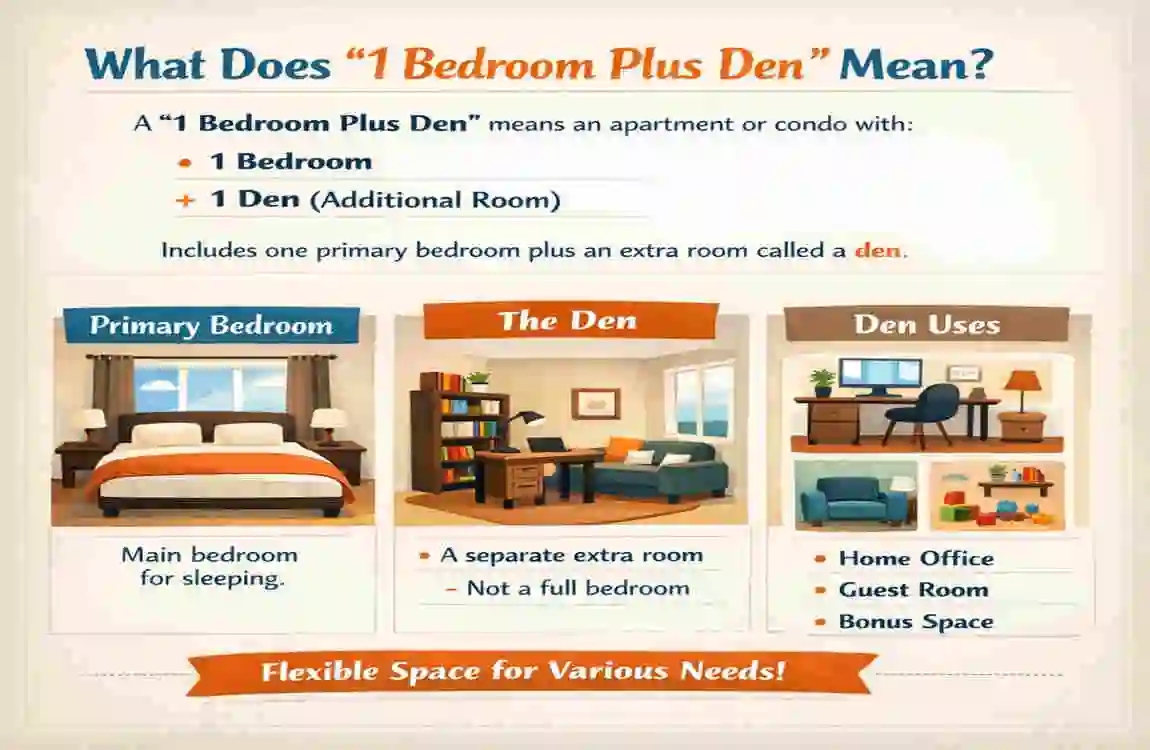
To truly grasp the value of these properties, we first need to answer our main question—what does 1 bedroom plus den mean—from a purely structural standpoint. When a real estate agent shows you a listing, they have to follow strict rules about how they describe the rooms.
What Exactly Is a 1 Bedroom Plus Den?
At its core, a 1-bedroom plus den is a residential unit that provides one primary sleeping quarter and a secondary bonus room.
The primary bedroom is a fully realized room. It features four walls, a door that closes for privacy, a built-in closet for your wardrobe, and, crucially, a window that leads to the outside world. This window is legally required for emergency escapes and ventilation.
The den, on the other hand, is a wildcard. Think of it as a bonus area. It is generally smaller than your main bedroom. Most notably, a den usually lacks a built-in closet. In many apartment buildings and condos, the den might not even have a window.
You will frequently find these layouts in high-rise condos and suburban townhouses. They typically range between 600 and 800 square feet. This size makes them highly manageable but still spacious enough to breathe comfortably.
To help you visualize the difference, let us look at a simple comparison table:
Feature 1 Bedroom + DenStandard 1 Bedroom
Rooms Included: Primary Bedroom + Den + Living Room, Primary Bedroom + Living Room.
Den Characteristics Often lacks a window or built-in closet N/A (Does not exist in the layout)
Typical Size Range 600 – 800 sq ft 500 – 700 sq ft
Primary Use Case Sleeping + Working/Hobbies Sleeping + Basic Living
Den vs Bedroom: The Key Differences
You might be wondering why builders do not just slap a door on the den and call the unit a two-bedroom home. The answer lies in strict building codes and safety regulations.
To be legally classified as a bedroom, a room must meet specific criteria. It must have an “egress window.” This means the window must be large enough for a person to climb out of during a fire and for a firefighter to climb in. It also requires specific ceiling heights and heating and ventilation.
Because dens do not meet these legal requirements, developers cannot advertise them as bedrooms. A den might be tucked into the middle of the floor plan, far away from the exterior walls, which is why it lacks a window.
However, do not view this as a negative! In the context of a house, this distinction offers wonderful benefits for the house den. Dens are perfect for basement flex spaces or main-floor nooks row houses. They offer a quiet, secluded spot separate from your main living areas, without the hefty price tag of a legal second bedroom.
Historical Context and Popularity
To understand why the 1+1 layout is dominating the market today, we need to take a quick look back in time. Space design always evolves alongside human behavior.
From Efficiency Apartments to Modern Hubs
The concept of adding a small, flexible room to a living space dates back to the 1950s. During this post-war era, architects began designing “efficiency apartments.” They wanted to maximize every square inch of urban buildings. Early dens were little more than alcoves meant for reading or sewing.
Fast forward to the modern era, and the world has changed drastically. The massive work-from-home (WFH) boom that kicked off in 2020 completely transformed how we view our living spaces. Suddenly, a standard one-bedroom apartment felt far too cramped. People needed a place to put a desk that wasn’t right next to their bed or on their kitchen counter.
Why is the 1 Bedroom Plus Den Trending in 2026?
As we navigate 2026, the trend shows no signs of slowing. In fact, real estate market reports indicate a staggering 30% rise in urban listings featuring a 1+1 layout across s major cities.
Why is it so popular right now? It all comes down to the perfect blend of affordability and utility. In high-demand, affluent areas Bahria Town, buying a traditional two-bedroom property is incredibly expensive. Young professionals want the prestige and safety of these Premium neighborhoods, but they might not have the budget for a massive home.
The 1-bedroom1-bedroom plus den is the ultimate affordable upgrade. It gives modern workers exactly what they need: a dedicated place to sleep, a place to relax, and a distinct place to hustle.
Layouts and Variations: Finding Your Perfect Flow
When you ask what a 1-bedroom plus den means, the answer can look slightly different depending on the specific property. Architects love to play with this layout. Because window requirements do not restrict a den, builders can place it almost anywhere in the floor plan.
Typical Floor Plans
Let’s walk through some of the most common setups you will encounter during your house hunt.
The first popular variation is the open-concept den. In this layout, the den flows directly off the kitchen or the living room. It might not even have a door. Instead, it sits in a recessed alcove. This creates a beautiful, fluid movement through the home. It makes the entire apartment feel much larger than its square footage suggests.
The second common variation is the separated den. Here, the den functions like a traditional room with its own door, typically located near the apartment or townhouse entryway. This is fantastic if you want to keep your work messes hidden from guests when they arrive.
When you look at single-family homes or townhomes, the layout shifts again. You might find a ground-floor office right off the main foyer. This allows you to host client meetings without bringing people through your private living spaces.
Here are a few benefits of these varied floor plans:
- Fluid movement: You can navigate your home easily by utilizing multi-functional furniture.
- Ultimate Customization: You can add built-in bookshelves or create an open kitchen-to-den flow that suits your lifestyle.
- Privacy Control: You choose how much separation you want between your living and working zones.
House vs Apartment Applications
It is vital to realize that the 1+1 layout is not exclusively for high-rise apartment living. It is also widely used in townhouses and semi-detached homes.
If you are browsing the Multiple Listing Service (MLS), you will often see townhomes listed with a 1+1 notation. In these properties, the main floor usually hosts the living room and kitchen, the upper floor holds the primary bedroom, and the basement or ground floor features the den.
This specific application maximizes small footprints, particularlysemi-detached homes. It gives you a basement flex space that feels entirely separate from the rest of the house. You get the multi-level living experience without paying for excess square footage you don’t actually need.
Pros and Cons of 1 Bedroom + Den
Every architectural layout has its bright spots and its limitations. To figure out whether this home style is right for you, we must weigh the pros and cons. Understanding the house’s benefits and drawbacks will help you make a smart investment.
Top Advantages of the Layout
There are numerous reasons why buyers and renters are clamoring for these units. Here are the top three advantages:
- Unmatched Versatility: This is the biggest selling point. You are buying a blank canvas. Today, it might be your home office. Tomorrow, it could be your personal yoga gym. A few years down the line, it could transform into a cozy nursery for a newborn. In our 2026 remote-working culture, having a WFH-perfect room is essential.
- Incredible Cost Savings: Your wallet will thank you. Generally speaking, a 1-bedroom plus den is 20% to 30% cheaper to buy or rent than a full two-bedroom unit. You save significantly on the initial purchase price and on ongoing property taxes and utility bills.
- High Space Efficiency: You gain extra storage space or a spot for a guest futon without committing to the upkeep of a full second bedroom. For young professionals living in a house, this means enjoying a low-maintenance lifestyle. You have exactly enough room, but not so much room that you spend your entire weekend cleaning.
Potential Drawbacks to Consider
Of course, we must look at the flip side. What are the downsides of asking what a 1-bedroom plus den means for your daily life?
The primary drawback is the lack of natural light. Because dens often lack windows, they can feel a bit dark or claustrophobic if not decorated properly. They rely heavily on artificial lighting.
Furthermore, a den is not ideal for older children or teenagers who need their own true, private bedrooms with closets and natural sunlight.
Let’s compare the financial and practical differences in a quick table:
Aspect1 Bed + Den2 Bedroom
Average Price 5 Million – 8 Million 8 Million – 12 Million
Room Flexibility High (Den can be used for anything) Medium (Usually strictly a bedroom)
Natural Lighting Lower (Den is often windowless) Higher (Both bedrooms have windows)
Resale Audience : Young professionals, singles , Expanding families
Ideal Users and Real-Life Uses
Now that we know the structural details, let us talk about the human element. Who actually thrives in a 1-bedroom plus den?
Who It’s For
This layout is a dream come true for specific demographics. It is tailored for single professionals, young couples just starting out, remote workers, and empty nesters looking to downsize.
Looking specifically, the city is experiencing a massive boom in the IT sector. We are seeing a rising number of freelancers, software developers, and digital marketers. These individuals do not necessarily need a massive family home, but they desperately need a quiet corner to take Zoom calls. The 1+1 layout fits their lifestyle perfectly.
Creative Use Cases
How do you actually use a den? The possibilities are limited only by your imagination. You do not have to use it as a traditional office.
- The Ultimate WFH Setup: You can install a sleek, foldable desk, some floating shelves, and an ergonomic chair. Close the door at 5 PM, and you instantly separate your work life from your home life.
- The Guest Nook: If you frequently have friends crashing over, put a high-quality pull-out sofa or a Murphy bed in the den. It becomes an instant guest room without wasting space when no one is visiting.
- The Hobby Room: Do you love painting, gaming, or crafting? Turn the den into your creative sanctuary.
- The Pet Zone: In houses and larger townhomes, many owners turn the den into a dedicated space for their pets, complete with cozy beds and toy storage.
- The Meditation Space: Throw down some floor cushions, add some ambient lighting, and create a quiet, tech-free zone for mental wellness.
Case studies show that the popularity of these creative spaces in major Western cities, such as Chicago, is now translating directly urban trends. People everywhere are craving personalized spaces.
Comparisons to Other Layouts: Making the Right Choice
When you are house hunting, you are constantly comparing one option against another. To fully answer what a 1-bedroom plus den means in the context of your search, we need to compare it to the alternatives on the market.
1 Bed + Den vs 2 Bedroom
The battle between the den vs. the bedroom is the most common dilemma buyers face.
As we established, the den is significantly cheaper and highly flexible. However, it lacks the legal status of a bedroom. If you have two kids who need separate rooms, a 1+Den will not work for you. But if you only have occasional guests, paying millions of extra rupees for an empty second bedroom is a massive waste of money.
Use this table to help guide your decision for better SEO and personal planning:
Deciding Factor 1+Den Wins If…2 Bed Wins If…
Your Budget: Stay under 7M PKR. You have a larger budget and need space
Your Space Needs: an office, a gym, or storage. You need an everyday sleepover space.
Future Plans: You plan to stay single or be with a partner. You plan to start a family very soon
Maintenance: You prefer quick, easy cleaning. You don’t mind extra household chores
Vs Studio or 1 Bed Only
On the other end of the spectrum, consider a studio apartment or a standard one-bedroom unit to save even more money.
While a studio is the cheapest option, it offers zero privacy. Your bed is in your living room, which is in your kitchen. A 1-bedroom plus den offers much more separation than a studio.
Even compared to a standard 1-bedroom unit, the den offers a critical psychological advantage. When you work from home in a standard 1-bedroom, you usually work at your dining table. With a den, you can physically leave your “office” at the end of the day. That mental separation is priceless.
Design and Optimization Tips
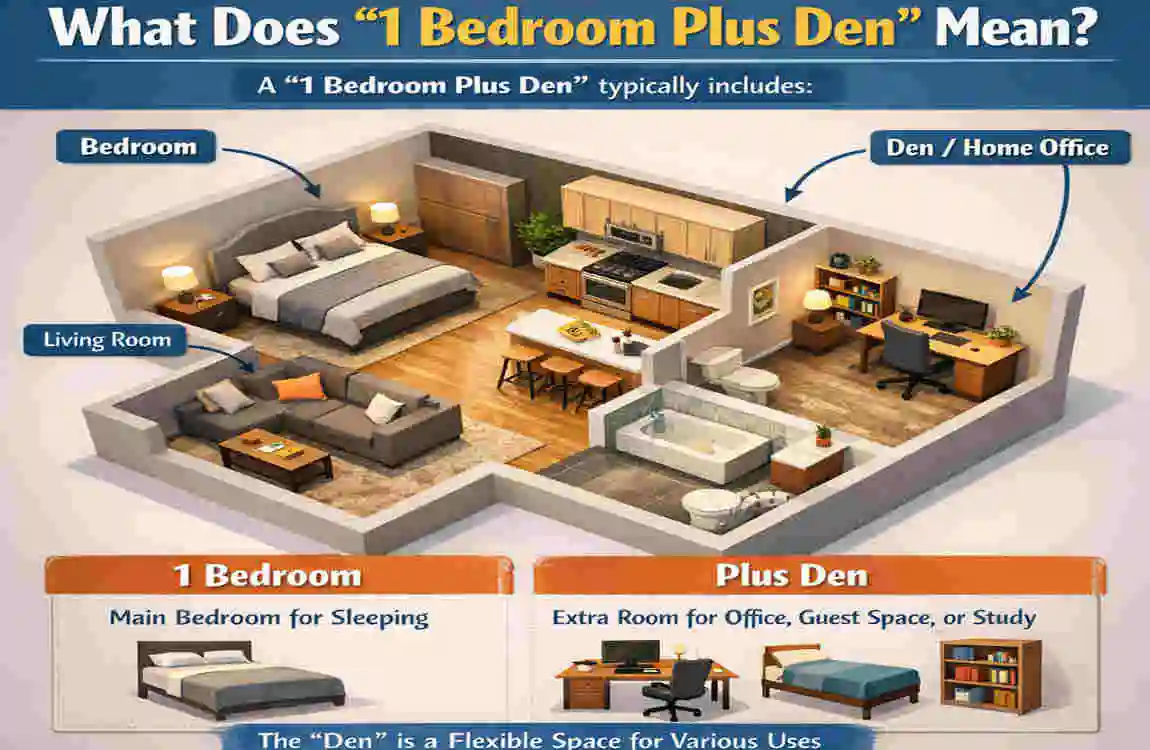
Because a den is often a smaller, sometimes windowless room, it requires a bit of strategic interior design to reach its full potential. You want to make sure the space feels inviting, not like a dark storage closet.
Master the Art of Lighting
If your den lacks an egress window, lighting is your absolute best friend. Do not rely on a single, harsh overhead bulb. Instead, layer your lighting. Use a stylish floor lamp in the corner to cast a warm glow. Add a dedicated task lamp on your desk for reading. You can even install LED strip lights behind your computer monitor to reduce eye strain. Choose lightbulbs with a “daylight” or “warm white” color temperature to mimic the sun.
Utilize Multi-Functional Furniture
You must maximize your square footage. Avoid bulky, heavy furniture. Instead, opt for pieces that serve dual purposes.
- Buy an ottoman with hidden storage.
- Invest in a nesting desk that can slide away when not in use.
- Use floating shelves instead of massive bookcases to keep the floor clear.
House Hacks and Smart Tech
If you are dealing with a den in a townhouse, consider built-in carpentry. Custom-built-in desks and cabinets look incredibly high-end and make the most of every millimeter of space.
To make an open-concept den feel intentional, use “zoning.” Place a large, colorful rug on the den floor. This visual cue tells the brain that this space is separate from the living room, even if there are no walls.
Furthermore, embrace 2026 smart home trends. Install smart lighting that you can control with your voice, or automated climate control to ensure the small room never gets too stuffy.
Market Insights
Understanding what a 1-bedroom plus den means isn’t just about floor plans; it is about making a smart financial investment in your local market.
The real estate landscape, particularly in bustling hubs like Islamabad, and Karachi, is shifting rapidly. We are currently experiencing a housing shortage for middle-income professionals. Developers are responding by building smarter, more compact homes.
Local Pricing and Demand
In prime locations like Bahria Town or, a brand-new 1-bedroom plus den townhouse or high-end condo currently averages around PKR 6-8 Million.
Demand for these specific 1+1 layout units has shot up by 25% over the last two years. Investors are scooping them up because they are incredibly easy to rent out. Young professionals are eager to rent them because they offer the WFH spaces they desperately need.
If you are looking to invest in a property that yields high rental returns, or want an affordable entry point into a luxury neighborhood, the 1-bedroom1-bedroom plus den is currently the smartest play in market.
Frequently Asked Questions (FAQs)
We know that navigating property listings raises many specific questions. Here are the answers to some of the most common voice search and inquiry questions we receive.
What does 1 bedroom plus den mean in house listings?
In a house listing, it means the property features one primary, legally compliant bedroom, alongside an extra, smaller room (the den). In houses, the den is often located on the ground floor or in a finished basement, serving as a flex space for an office or storage.
Can a den be used as a bedroom?
Practically speaking, yes. You can put a bed in a den and sleep there, or use it for overnight guests. However, legally speaking, a landlord or seller cannot advertise it as a bedroom because it usually lacks the required egress window and closet space mandated by fire safety codes.
What is the average size of a 1-bedroom plus den
In new developments across Lahore and Karachi, these units typically range from 600 to 800 square feet. This provides ample space for a comfortable living room, a full kitchen, the primary bedroom, and the versatile den.
Is a 1-bedroom plus den good for resale value?
Absolutely. Because of the rising trend in remote work and the high cost of traditional two-bedroom homes, the 1+1 layout is highly sought after by young professionals and investors. It holds its value incredibly well in urban centers.
How is a den different from a sunroom?
A sunroom is an enclosed space with walls made entirely or mostly of glass, designed specifically to capture natural light. A den is an interior room, often without windows, designed for privacy and flexible use.
