
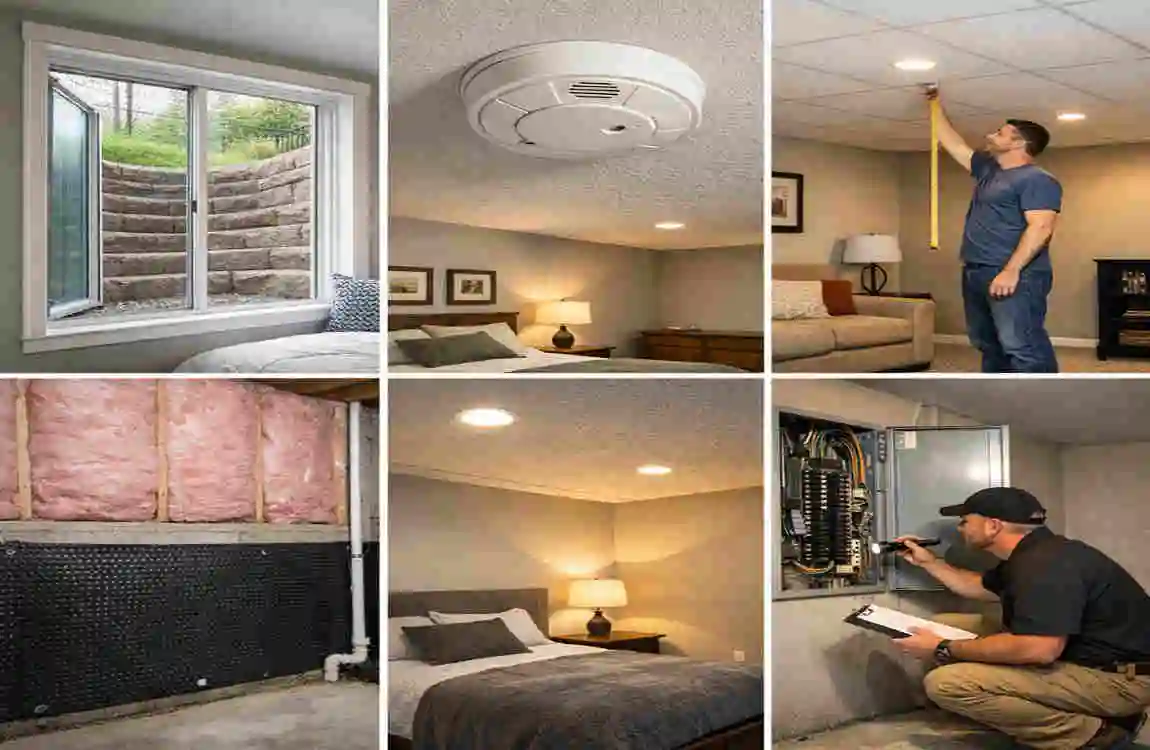
Imagine this: You have just finished a beautiful basement renovation. You spent thousands of dollars installing drywall, laying plush carpet, and painting the walls a warm, inviting colourcolour. You rent it out to a nice tenant and start collecting that extra monthly income. Then, a few months later, there is a knock at your door. A city inspector hands you a citation, orders your tenant to move out immediately, and slaps you with a $10,000 fine for operating an illegal basement rental.
This nightmare scenario happens to well-meaning homeowners every single day. As we move deeper into 2026, the demand for affordable housing and multi-generational living spaces is higher than ever. Homeowners are frantically looking for ways to maximise their square footage. However, simply throwing a mattress into a finished underground room does not make it a bedroom.
So, what makes a bedroom legal in a basement? The short answer is that a legal basement bedroom must meet strict local and international building codes regarding egress (escape routes), ceiling heights, room dimensions, and proper ventilation.
Why Legal Basement Bedrooms Matter for Your Home
Before we dive into the exact measurements and technical rules, it is vital to understand why these building codes exist in the first place. Some homeowners view building permits and housing codes as annoying bureaucratic red tape. In reality, these rules are written in blood—they exist to save lives.
The True Benefits of Compliance
When you follow the rules for what makes a bedroom legal in a basement, you unlock incredible benefits for your property.
First, you gain a legitimate, recognisable living space. When it comes time to sell your house, a real estate agent can officially list that basement room as a bedroom. A three-bedroom house suddenly becomes a four-bedroom house, instantly pushing your property into a higher price bracket.
Second, you open the door to secure rental income. Legal basement apartments attract higher-quality tenants who are willing to pay a Premium for a safe, well-lit, and comfortable living space.
The Severe Risks of Non-Compliance
Ignoring the rules is a massive gamble. The risks of non-compliance go far beyond simple fines.
- Safety Hazards: The most terrifying risk is a fire. If a fire starts on the main floor and blocks the basement stairs, anyone sleeping in an illegal basement bedroom without a proper escape window is trapped.
- Insurance Denials: If an electrical fire starts in your unpermitted basement bedroom, your homeowner’s insurance company is highly likely to deny your claim. You could lose your entire house and receive zero compensation.
- Massive Fines: Municipalities are cracking down. Statistics from early 2026 show that nearly 40% of homes fail municipal inspections specifically due to unpermitted, illegal basement renovations.
Modern House Relevance
Today’s homes are doing double duty. With the massive shift toward remote work and the reality of expanding, multi-generational families, we need our houses to work harder for us. Transforming a damp, dark storage space into a vibrant home office or a cosy suite for your ageing parents is a brilliant move—as long as you do it by the book.
Let’s transition into the exact core code essentials you need to follow.
Core Legal Requirements: What Makes a Bedroom Legal in a Basement
When building inspectors evaluate your home, they are reviewing a checklist of safety and habitability standards. Here is a detailed breakdown of the fundamental elements that determine whether a bedroom is legal in a basement.
Egress Windows – Your Essential Escape Route
If you remember nothing else from this guide, remember this: You cannot have a legal bedroom without a proper egress window.
“Egress” means a way to get out. In the event of an emergency, you need a safe escape route, and emergency responders (like firefighters wearing heavy oxygen tanks and gear) need a way to get in.
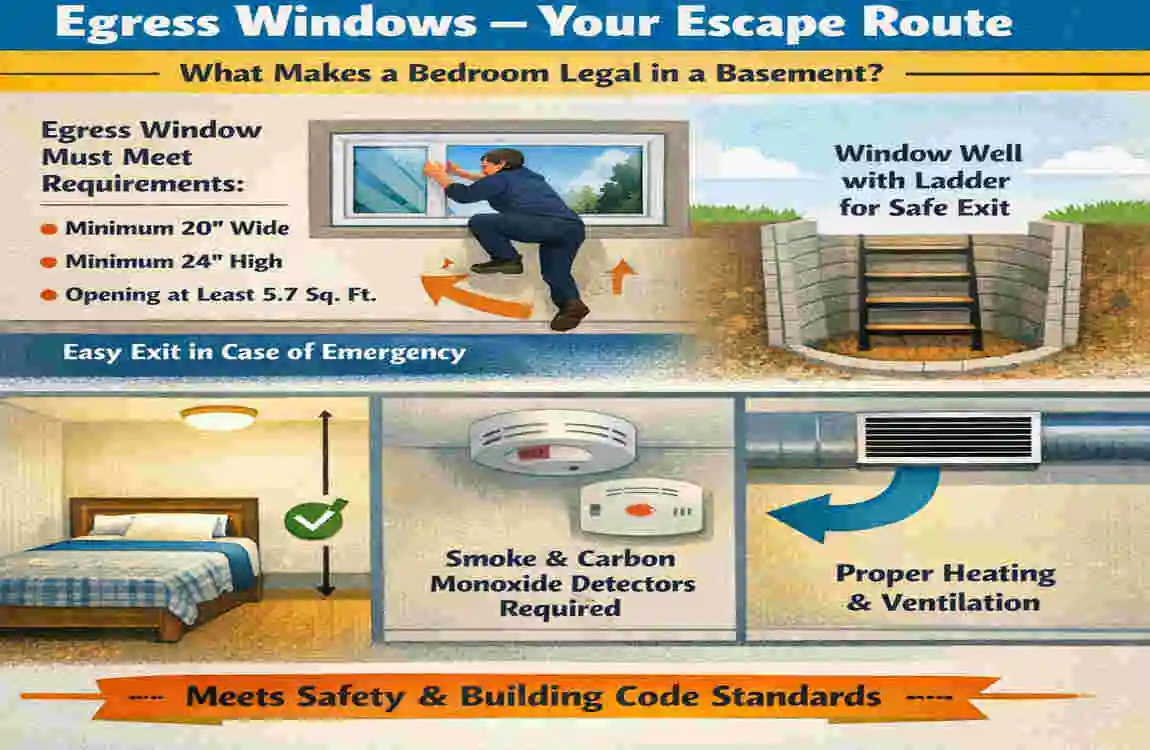
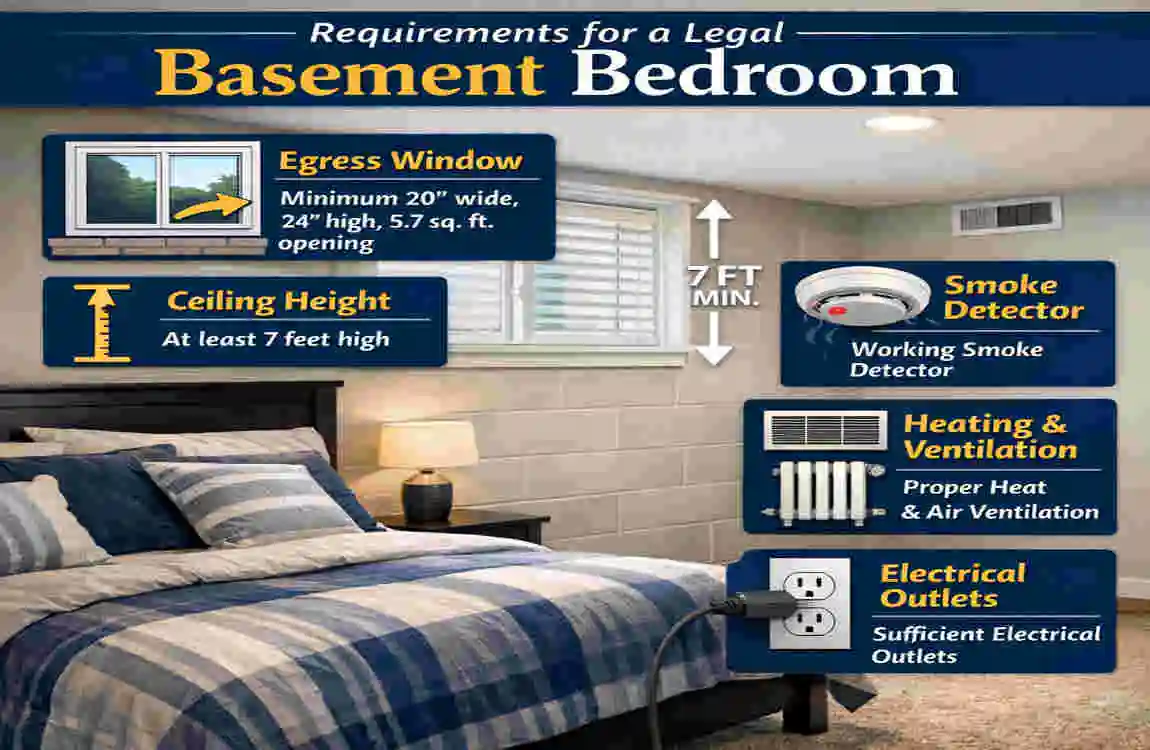
According to the International Residential Code (IRC) R310, an egress window must meet these strict minimum requirements:
- Minimum opening width: 20 inches.
- Minimum height of opening: 24 inches high.
- Minimum net clear opening: 5.7 square feet (or 5.0 square feet if it is located on the ground floor, though basements almost always require the 5.7 standard).
- Maximum sill height: The bottom of the window opening can be no higher than 44 inches from the finished floor.
Why are these measurements so specific? A 20-inch-by-24-inch opening is the absolute smallest space a fully geared firefighter can squeeze through to rescue someone. Furthermore, if the window sill is higher than 44 inches, a child or an older adult will not be able to climb out during a smoke-filled panic.
House Tip: If your basement is completely underground, you will need to dig an exterior window well. This well must provide a minimum of 9 square feet of floor area, with a horizontal projection of at least 36 inches. If the window well is deeper than 44 inches, a permanent ladder or steps must be attached to the side. Retrofitting an egress window into solid concrete usually costs between $2,000 and $5,000, but it is a non-negotiable step.
Ceiling Height Standards for Comfort and Safety
Have you ever walked into a basement and felt the urge to duck, even though you aren’t that tall? Low ceilings make spaces feel cramped, dark, and uncomfortable. More importantly, they restrict proper airflow.
To figure out what makes a bedroom legal in a basement, you must look up. Under IRC R305, the rules for ceiling heights are clear:
- The Minimum Standard: Your finished basement bedroom must have a ceiling height of at least 7 feet.
- Exceptions for Obstacles: If you have exposed structural beams, air conditioning ducts, or plumbing pipes running across the ceiling, the height can drop to 6 feet 8 inches, but only in those specific obstructed areas.
- Sloped Ceilings: If your room has a sloped or angled ceiling, at least 50% of the required floor area must have a ceiling height of 7 feet or more. Any area where the ceiling drops below 5 feet does not count toward your legal square footage.
Having a proper ceiling height significantly impacts the psychological feel of the house. It turns a “dungeon” into a welcoming, breathable living space.
Minimum Bedroom Size and Layout Rules
You cannot put a door on a tiny storage closet and legally call it a bedroom. Human beings need a minimum amount of space to live comfortably and safely.
- Minimum Square Footage: The room must be at least 70 square feet.
- Minimum Dimensions: The room cannot be narrower than 7 feet in any horizontal direction. This ensures that a standard bed can actually fit into the room alongside basic furniture.
- Door Access: The bedroom must have a door at least 36 inches wide to accommodate emergency exits and facilitate movement.
- Layout Restrictions: You generally cannot have the only access to a full bathroom located inside the bedroom if that bathroom is meant to serve the rest of the basement. Furthermore, the bedroom cannot serve as the only hallway or access point to other vital areas of the house (like the utility room).
Realtor Definition vs Code: Many people mistakenly believe that a bedroom must have a built-in closet to be legal. From a strict IRC building code perspective, a closet is not actually required for safety. However, from a real estate perspective, most agents will not list a room as a bedroom unless it has a closet. Always build a closet to maximise your home’s value.
Ventilation and Natural Lighting Guidelines
A healthy room requires fresh air and sunlight. Without them, basements quickly become breeding grounds for toxic black mould and mildew.
- Natural Light Requirements: The glass area of your windows must equal at least 8% of the total floor area of the bedroom. For example, if your bedroom is 100 square feet, you need at least 8 square feet of window glass to let in sunlight.
- Ventilation Requirements: The openable section of your windows must equal at least 4% of the floor area (or 1 square foot of ventilation per 150 square feet of floor space).
While mechanical ventilation (such as HVAC systems) and artificial LED lighting can sometimes offset these rules, depending on local amendments, natural light and air are the gold standards for a legal, comfortable space.
Heating, Electrical, and Plumbing Codes You Must Follow
Knowing what makes a bedroom legal in a basement goes beyond just walls and windows. The internal systems running behind the drywall are heavily regulated to ensure energy efficiency and absolute safety.
Proper Heating and Energy Insulation
Nobody wants to sleep in a freezing basement. According to building codes, every habitable room must be equipped with a heating system capable of maintaining a minimum room temperature of 75°F (24°C) at a point 3 feet above the floor.
Important Note: You cannot simply plug in a portable electric space heater and call it a day. The heating source must be a permanently installed fixture, such as an extension of your home’s central HVAC system, hardwired electric baseboard heaters, or radiant floor heating.
Additionally, you must comply with modern energy codes regarding insulation:
- Wall Insulation: Basement walls typically require a minimum of R-10 to R-13 insulation, depending on your climate zone. This keeps the cold earth from pulling heat out of your home.
- Ceiling/Floor Insulation: If the basement is unheated, the ceiling above it (the floor of the main level) usually requires R-19 insulation.
Proper insulation lowers your energy bills and prevents the damp, chilly feeling commonly associated with underground living.
Electrical Rules and Smoke Safety
Electricity and underground environments can be a deadly combination if not handled properly. Water naturally flows downward, making basements prone to moisture, which is why electrical codes are incredibly strict.
- GFCI Outlets: Any electrical outlets located in unfinished areas, or near water sources (like a basement bathroom or wet bar adjacent to the bedroom), must be Ground Fault Circuit Interrupter (GFCI) protected. These outlets instantly shut off power if they detect a short circuit, preventing electrocution.
- Arc-Fault Breakers: Modern codes require Arc-Fault Circuit Interrupters (AFCI) for all bedroom circuits. These prevent fires caused by sparking wires inside the walls.
- Smoke and CO Detectors: You must install a hardwired smoke detector (with a battery backup) directly inside the basement bedroom, and another one in the hallway immediately outside the bedroom. Furthermore, a Carbon Monoxide (CO) detector is mandatory if your home has natural gas appliances or an attached garage. Detectors should generally be placed every 15 feet in long hallways.
Plumbing and Moisture Rules
While you might not have plumbing in the bedroom, the overall basement environment still affects the room’s legal status.
- Moisture Barriers: You must install a proper vapour barrier behind the drywall to prevent groundwater from seeping into the insulation and causing structural rot and mould.
- Sewage Lines: You cannot have exposed, direct raw sewage lines running openly through a habitable bedroom. All plumbing must be properly enclosed behind drywall or drop ceilings.
- Ejector Pumps: If you are adding a bathroom near the new bedroom, and it sits below the level of your municipal sewer line, you will need a permitted sewage ejector pump to push wastewater up and out of the house safely.
Local Code Variations: From the US and UK
While the principles of safety remain the same globally, the specifics of what makes a bedroom legal in a basement vary by where you live. Geography, climate, and local government regulations play a massive role.
United States IRC Basics
In the United States, the baseline for residential construction is the International Residential Code (IRC). Think of the IRC as the foundational rulebook. However, the federal government does not enforce these rules; local municipalities do.
Because of this, individual states and cities take the IRC and tweak it to fit their specific needs. For example:
- California: Due to frequent earthquakes, basement walls require much heavier seismic retrofitting and specific structural steel reinforcements.
- The Northeast (New York, Massachusetts): Because the winters are brutal, the frost line is very deep. Egress window wells must be dug deeper, and insulation requirements (often R-15 to R-20 for walls) are much stricter to combat the freezing temperatures.
International Differences Explained
When we look outside the US, the codes adapt to different environmental realities.
- Canada: Canadian building codes are very similar to the US IRC, but they place a heavy emphasis on extreme-weather insulation and frost protection. The frost line in Canada is exceptionally deep, meaning foundations and egress wells must be heavily protected from freezing and cracking.
- United Kingdom: In the UK, basement conversions are often called “cellar conversions.” The British regulations require slightly higher ceilings (around 2.3 meters or 7’7″). The main focus in the UK is on aggressive damp-proofing (tanking) due to the consistently wet climate. In cities like , the Punjab Building Code governs construction. The climate here features intense summer heat and high humidity, especially during the monsoon season. Therefore, local codes heavily prioritise high-volume cross-ventilation to prevent dampness and fungal growth in basements. Egress is still required, but managing humidity through larger air vents is a massive focus.
Here is a quick comparison table to help you understand the global differences.
Country/Region Minimum Ceiling Height Egress Window Size Key Focus / Local Note
US (IRC) 7 ft (2.13m) 5.7 sq ft Fire safety and escape routes.
Canada 6’11” (2.1m) 3.8 sq ft Heavy insulation and frost-line depth.
UK 7’7″ (2.3m) 0.33 sq m. Strict damp-proofing (tanking) requirements.
(Punjab) 7’6″ (2.28m) Varies locally Maximum ventilation for monsoon humidity.
How to Check Your Local Rules
Never assume that the general IRC rules apply perfectly to your specific street. To find out exactly what makes a bedroom legal in a basement in your neighbourhood, you must do some legwork.
- Contact Your Municipality: Call your local city hall or county building department. Ask to speak to a residential building inspector.
- Use Online Portals: Most modern cities have their zoning laws and building codes available online. Search for your city’s “Department of Buildings” or “Permit Office.”
- Consult a Professional: A local, licensed general contractor will already know the specific quirks and requirements of your town’s building codes.
Step-by-Step: Converting Your Basement Legally
Now that you understand the rules, how do you actually execute the project? Turning a dark storage space into a legal, income-producing bedroom is a journey. Follow these step-by-step instructions to ensure you stay completely on the right side of the law.
Assess Your Current Setup
Before you spend a single dime, walk down to your basement with a tape measure. Measure the height from the concrete floor to the lowest hanging pipe or duct. Is it at least 6 feet 8 inches? If not, you may have to relocate plumbing or dig out the concrete floor (both of which are incredibly expensive). Check the walls for any signs of water damage, white powdery stains (efflorescence), or mould. You cannot build a legal bedroom in a space that actively leaks water.
Hire an Inspector or Structural Engineer
Do not rely on your own DIY knowledge for structural integrity. Hire a licensed home inspector or a structural engineer to evaluate your foundation. They will tell you exactly where it is safe to cut a massive hole in your concrete foundation wall for an egress window. Cutting into the wrong spot could compromise the structural integrity of your entire house, causing your living room floor to sag or collapse.
Obtain the Necessary Building Permits
This is the step most amateur DIYers skip, and it is the biggest mistake you can make. Take your drawn-up floor plans to your local permit office. You will typically need a building permit, an electrical permit, and a plumbing permit (if adding a bathroom).
- Cost Expectation: Depending on your city, permit fees generally range from $500 to $2,000.
- The Waiting Game: It can take anywhere from a few days to several weeks for the city to review and approve your plans. Do not start demolition until the permit is physically taped to your front window.
install Egress and Fix Height Issues
Once permitted, the heavy construction begins. This is usually the loudest and messiest part of the project.
- Excavation: Workers will bring heavy machinery to dig a large hole on the exterior of your house for the window well.
- Concrete Cutting: Using specialised diamond-blade saws, contractors will slice through your foundation wall to create the 20×24 (or larger) opening.
- Installation: The new egress window is framed, installed, sealed, and waterproofed. Proper drainage at the bottom of the exterior window well must be tied into your home’s perimeter drain system so it doesn’t turn into a fish tank when it rains.
Pass the Final Inspection
As construction progresses, the city inspector will visit your home multiple times. They will do a “rough-in” inspection to check the bare electrical wires and plumbing pipes before the drywall goes up. Once the room is painted, the carpet is laid, and the smoke detectors are wired, they will return for the “final inspection.”
When the inspector signs off and issues your Certificate of Occupancy (CO), congratulations! You officially know exactly what makes a bedroom legal in a basement, and you now own a 100% compliant, valuable piece of real estate.
Common Mistakes and How You Can Avoid Them
Even with the best intentions, homeowners often stumble into costly traps during basement renovations. Here are the most common pitfalls and how to avoid them to ensure the longevity of your house.
- Skipping the Permits: We have said it before, but it bears repeating. Trying to fly under the radar without permits can result in stop-work orders, fines up to $5,000, and the city forcing you to tear down all your expensive drywall so that they can see the wiring underneath. Always pull permits.
- Buying Cheap Windows: Homeowners often try to save money by buying standard sliding windows instead of certified egress windows. Even if the window glass seems big enough, the actual opening when you slide the pane might fail the 5.7-square-foot openability test. Always buy windows explicitly labelled for “Egress.”
- Ignoring Moisture and Humidity: Basements are naturally humid. If you just slap up fibreglass insulation and drywall without a proper vapour barrier, moisture will get trapped in the walls. Within a year, toxic black mould will bloom, posing a severe health hazard to anyone sleeping in the room. Invest in closed-cell spray foam insulation or high-quality vapour barriers.
- DIY Electrical Work: Wiring an outlet wrong in a dry living room is bad; wiring it wrong in a potentially damp basement is catastrophic. Always hire a licensed electrician to handle AFCI/GFCI circuits and hardwired smoke alarms.
Cost Breakdown and Your Expected ROI
Legalising a basement bedroom is not cheap, but it is one of the smartest investments you can make in real estate. It is much cheaper than building a brand-new addition onto the side of your house, because the roof, foundation, and exterior walls already exist.
Here is a general breakdown of what you can expect to spend, and the Return on Investment (ROI) you will get when you sell your house.
Renovation / Upgrade Average Cost Range Expected ROI Boost to Home Value
Installing Egress Window $2,000 – $5,000 5% – 10%
Raising Ceiling Height (Dig-out) $3,000 – $10,000+ High (Makes space usable)
Full Bedroom Legalisation & Reno $20,000 – $50,000 15% – 25%
Understanding the Numbers: If you spend $5,000 adding an egress window to a beautifully finished (but previously illegal) basement room, you instantly transition that space from “bonus room” to “official bedroom.” On a $400,000 house, adding an official bedroom can increase the home’s appraisal value by $30,000 to $40,000. That is an incredible, almost immediate return on your initial $5K investment.
Real House Examples and Case Studies
Let’s look at how these codes apply in the real world.
Consider the Ahmed family, living in a standard house n. They wanted to create a rental suite in their basement to help pay down their mortgage. Initially, the basement was dark, had small ventilation slits near the ceiling, and suffered from high humidity during the monsoon season.
Instead of just throwing up cheap walls, they decided to follow the Punjab Building Code properly. They invested in digging a proper exterior light well and installing a massive egress-compliant window to allow maximum cross-ventilation. They also installed a dedicated dehumidifier system and proper moisture barriers.
The Result: Not only did they pass their municipal inspections with flying colours, but the influx of natural light and fresh air made the room feel incredibly luxurious. Because it was a safe, legal, and bright space, they were able to rent the bedroom to an expatriate professional for 30% above the average neighbourhood rental rate. The renovation paid for itself in less than two years.
FAQ: Quick Answers on Legal Basement Bedrooms
Still have questions? Here are the rapid-fire answers to the most common homeowner questions about building codes.
Q: What makes a bedroom legal in a basement without windows? A: Nothing. A basement bedroom without a window is 100% illegal everywhere. You must have an egress window to provide an emergency escape route and allow firefighters to enter. There are zero exceptions to this safety rule for sleeping quarters.
Q: How much does it cost to legalise an existing basement bedroom? A: If the room is already framed and drywalled, but lacks a proper escape route, retrofitting an egress window and updating the smoke detectors will cost an average of $5,000 to $10,000. If you need to rip out walls to fix plumbing, wiring, or ceiling heights, costs can exceed $20,000.
Q: Can a landlord be sued if a tenant is injured in an illegal basement bedroom? A: Absolutely. If a tenant is injured or killed in a fire in an illegal basement bedroom, the landlord is held legally and criminally liable. Your landlord insurance will also void your coverage, leaving you personally responsible for millions of dollars in damages.
Q: Do I need to put a closet in the room for it to be legal? A: Building codes (like the IRC) focus strictly on safety—they do not require a closet. However, real estate agents and local market standards usually dictate that a room must have a closet to be officially listed and sold as a “bedroom.”
