
Imagine this: You’re helping your aging parents stay in their forever home, or maybe you’re planning for your own mobility needs down the road. A simple trip to the bathroom turns into a daily challenge without the proper setup. That’s where ADA bathrooms come in. These spaces comply with the Americans with Disabilities Act (ADA) guidelines to make homes safer and more accessible for wheelchairs, walkers, and individuals with limited mobility.
What Is an ADA-Compliant Bathroom
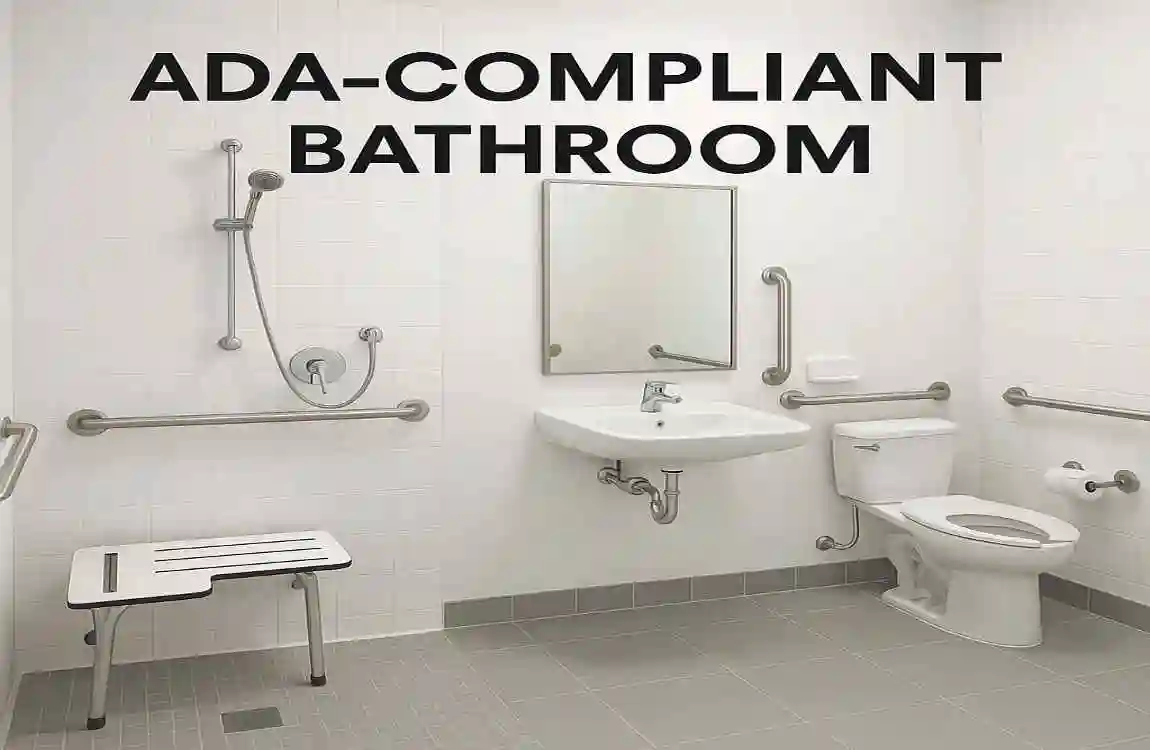
Let’s start with the basics. An ADA-compliant bathroom isn’t just a buzzword—it’s a practical space designed under U.S. accessibility standards. The ADA sets rules to ensure people with disabilities can use bathrooms easily. Think wide doors, plenty of turning space, and fixtures at the right heights.
In homes, we adapt these commercial standards to fit residential life. You don’t need every public restroom rule, but key tweaks make a huge difference. For example, the space must allow a wheelchair to turn freely. That means a 5-foot turning radius—about the size of a small hula hoop circle on the floor.
Doors swing wide at 60 inches or more, so no squeezing through narrow openings. Grab bars go near the toilet and shower for steady support. Toilets sit at comfort height (17-19 inches), easier to use than standard low ones. Roll-in showers replace tubs with zero-threshold entries—no pesky steps.
Here’s a quick list of core features every ADA bathroom needs:
- Turning radius: At least 60 inches (5 feet) of clear floor space.
- Door width: 32-36 inches clear opening (60-inch total width recommended).
- Grab bars: Mounted 33-36 inches high, reinforced for 250+ pounds.
- Shower: Roll-in style, minimum 30×60 inches, with bench and handheld showerhead.
- Sink and vanity: Knee space underneath, 34 inches max height.
- Controls: Within 48 inches reach, lever-style for easy gripping.
These changes aren’t just rules—they save lives. Falls in bathrooms cause thousands of injuries yearly. Plus, ADA bathrooms promote independence. You age in place comfortably, and your home appeals to more buyers later. Ever thought about how this could change your family’s daily routine? It’s more affordable than you might guess, with tangible benefits that last.
Average Costs Overview
Now, let’s talk numbers. Understanding average ADA bathroom costs helps you set realistic expectations. In 2026, national averages reflect rising material prices and labor demands, up about 5-10% from last year. A basic update might cost under $5,000, while a complete overhaul hits $25,000+.
Bathroom size plays a significant role. Small powder rooms (40 square feet) run cheaper than master suites (100 square feet). Urban areas like New York and San Francisco add 20-30% due to high labor and permit costs. Rural areas? Often 10-15% less.
Check this ADA bathroom cost breakdown table for quick insights:
Project TypeCost RangeAverage
Basic Modifications (grab bars, toilet swap) $2,700-$5,000 $3,500
Mid-Level Remodel (shower update, vanity) $5,000-$15,000 $8,400
Complete Custom Build (new layout, luxury finishes) $15,000-$25,000+ $20,000
These figures cover most U.S. homes. For a small house, aim for the low end—maybe $6,000 total. Larger projects in high-cost areas? Budget $25,000 easily.
What drives these accessible bathroom remodel prices? Fixtures like roll-in showers dominate, often 30-40% of the bill. Labor adds another chunk. But here’s the good news: Many see a return on investment through energy savings (low-flow fixtures) and increased home value.
Picture your budget: If you’re updating a guest bath, $8,400 gets you pro results. Compare quotes from three contractors to lock in the best deal. Does this match what you expected? Keep reading for the nitty-gritty details.
Detailed Cost Breakdown
This is the meat of it—your full ADA bathroom cost breakdown. We’ll slice it into phases, so you see where every dollar goes. Total costs hinge on scope, but expect $8,000-$20,000 on average. Pros handle 60-70% of this; materials take the rest.
Demolition & Prep
First up: Clearing the deck. Demolition tears out old tiles, tubs, or vanities. Costs range from $1,000 to $3,500, depending on the mess size. A simple grab-bar install? Under $1,000. Complete gut job in a 60-square-foot room? Closer to $3,000.
Why so variable? Old homes hide surprises like asbestos tiles or wonky floors needing reinforcement for that 5-foot turning radius. Pros check structure first—walls might need shoring for new layouts. Prep includes layout planning and debris haul-away.
Skip corners here, and you’ll pay later in fixes. Think of it as the foundation: Solid prep keeps your project on track and under budget.
Plumbing & Electrical
Plumbing shifts pipes for roll-in showers—no curbs means rerouting drains. Expect $500 to $1,600. A basic toilet swap is cheap; a full shower install with linear drains costs more.
Electrical upgrades add safety. GFCI outlets (lifesavers near water) cost $20-$100 each. Add lights, exhaust fans, or heated floors: $500-$2,000 total. Code requires everything accessible—switches at 48 inches max.
Combine these, and you’re at $1,500-$4,000. In older homes, wiring updates prevent shocks. Ever worry about bathroom hazards? These ensure compliance and peace of mind.
Fixtures & Features
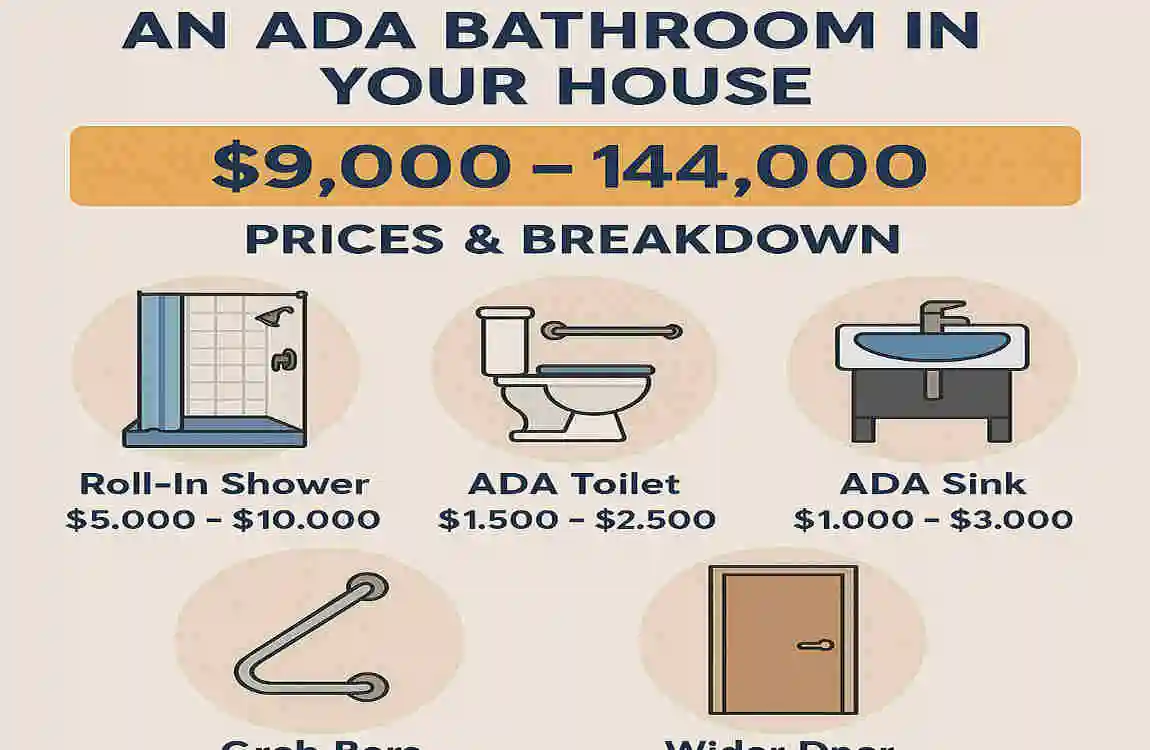
Fixtures steal the show—and budget. A roll-in shower alone? $3,000-$8,000, with glass doors and benches. ADA toilets (elongated, comfort height) run $250-$700. Grab bars? $100-$300 each, installed.
Sinks need open knee space: $150-$1,000. Flooring switches to non-slip porcelain or vinyl: $500-$2,000 for 50 square feet.
Here’s a handy table:
FeatureCost Range
Roll-in Shower $3,000-$8,000
ADA Toilet $250-$700
Grab Bars (per unit) $100-$300
Vanity/Sink $150-$1,000
Non-Slip Flooring $500-$2,000
Luxury picks like rain showers add $2,000+. Total here: $5,000-$12,000. Choose wisely—mid-range saves without skimping on safety.
Labor & Permits
Labor is 40-50% of your bill. Plumbers charge an average of $75/hour; general contractors (GCs) charge $45charge -$200/hour. A mid-level remodel takes 40-80 hours, so it costs $3,000-$10,000.
GCs add 10-20% fees for oversight. Permits? $200-$1,000, varying by city. Some areas require ADA inspections.
Hire licensed pros—they know codes cold. Your total labor hit: $4,000-$12,000. Factor this in early.
Factors Affecting ADA Bathroom Costs
Costs aren’t one-size-fits-all. Many things tweak your ADA bathroom cost. Let’s unpack the big ones.
Location matters most. Urban hubs charge 20-50% more for labor—think California vs. the Midwest, even within regions like Lahore or Punjab—adjusting for local rates and freight costs.
Existing layout? If walls need to be moved for clearances, add 50%. Structural changes like floor reinforcements skyrocket bills.
Material quality swings it too. Basic fiberglass shower: $3,000. Marble luxury: Double that. Custom vs. kits? Prefab kits save 20-30%—plug-and-play options.
Inflation hits 2026 hard: Up 5-10% from 2025 due to supply chains.
Here’s a list of top influencers:
- Location: +20% urban, -10% rural.
- Layout changes: +50% for major demos.
- Materials: Basic saves 30%; luxury adds 40%.
- Scope: Add-ons like heated floors pile on $1,000+.
- Inflation & timing: 2026 peaks in spring.
DIY tempts, but pitfalls abound—code violations mean rework costs. Pros ensure compliance. What’s your home’s setup like? Assess it to predict your quote.
Budget-Saving Tips
Short on cash? Smart moves cut accessible bathroom remodel prices without risks. Follow these steps.
- Prioritize essentials: Start with grab bars ($500) and toilet swap ($400). Add showers later.
- Embrace universal design: Fixtures work for everyone—future-proof without complete ADA overkill.
- Hunt sales: Big-box stores discount ADA toilets 20-30% seasonally.
- Get multiple quotes: Compare three pros; bundle plumbing/electrical for 10-15% off.
- Chase rebates: Tax credits up to $5,000 for accessibility mods. Check IRS or local programs.
These tips slash 20-40% off. Shop mid-range fixtures—they last. You got this—plan now, save big.
DIY vs. Professional Installation
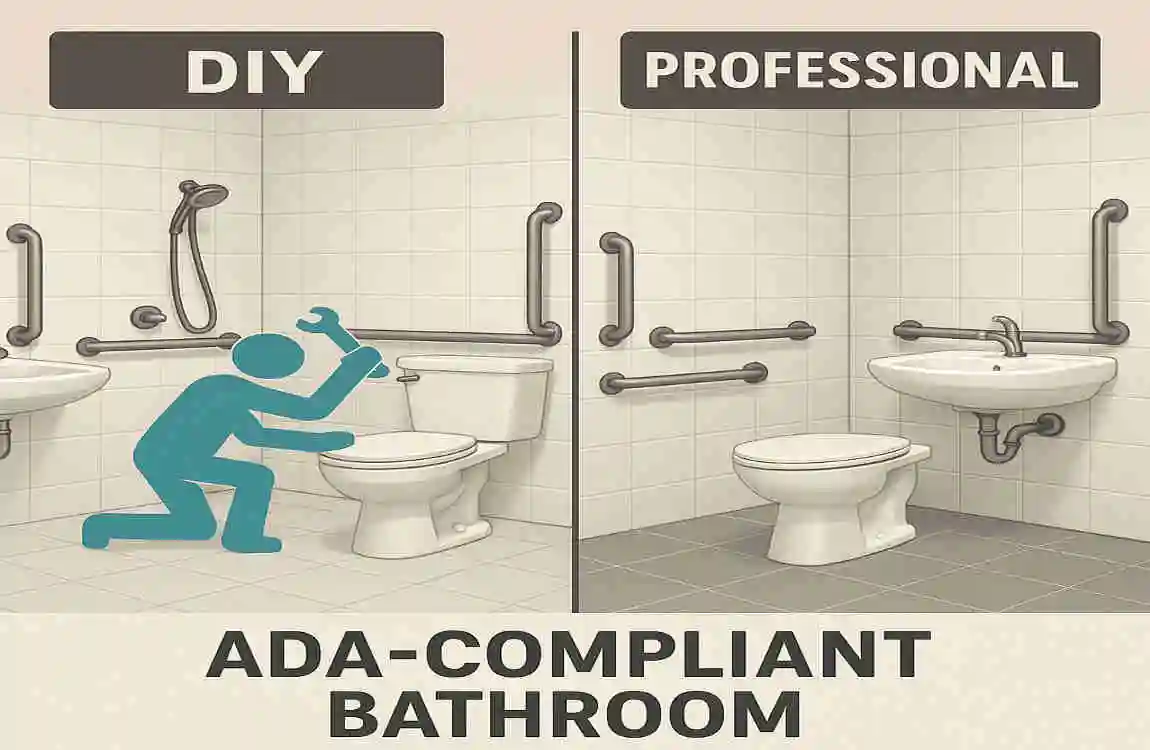
Tempted to DIY your ADA bathroom? Weigh options carefully.
AspectDIYProfessional
Cost Saves 30-50% (materials only) Full price, but no hidden fees
Time 1-2 weeks (your schedule) 4-6 weeks (pro efficiency)
Risks: Code violations, injuries. Warrantied, insured, compliant
Quality Variable skill-dependent Expert, long-lasting
DIY suits minor tweaks like grab bars. Full remodels? Call pros. ADA rules demand precision—mistakes cost more to fix. I recommend professionals for safety and value.
Real Examples & Case Studies
See it in action. Case 1: Sarah’s $12,000 mid-level remodel. Before: Cramped tub, narrow door. After: Roll-in shower, 60-inch door, grab bars. Total: $12K, done in 5 weeks. Independence gained.
Case 2: Mike’s basic mod for $4,200. Added comfort toilet, bars, non-slip floor—quick win for his mom’s walker use.
Case 3: Luxury complete build, $22,000. Custom vanity, heated floors in 80 sq ft. Resale boost: Priceless.
Real stories show $8,400 averages work.
