
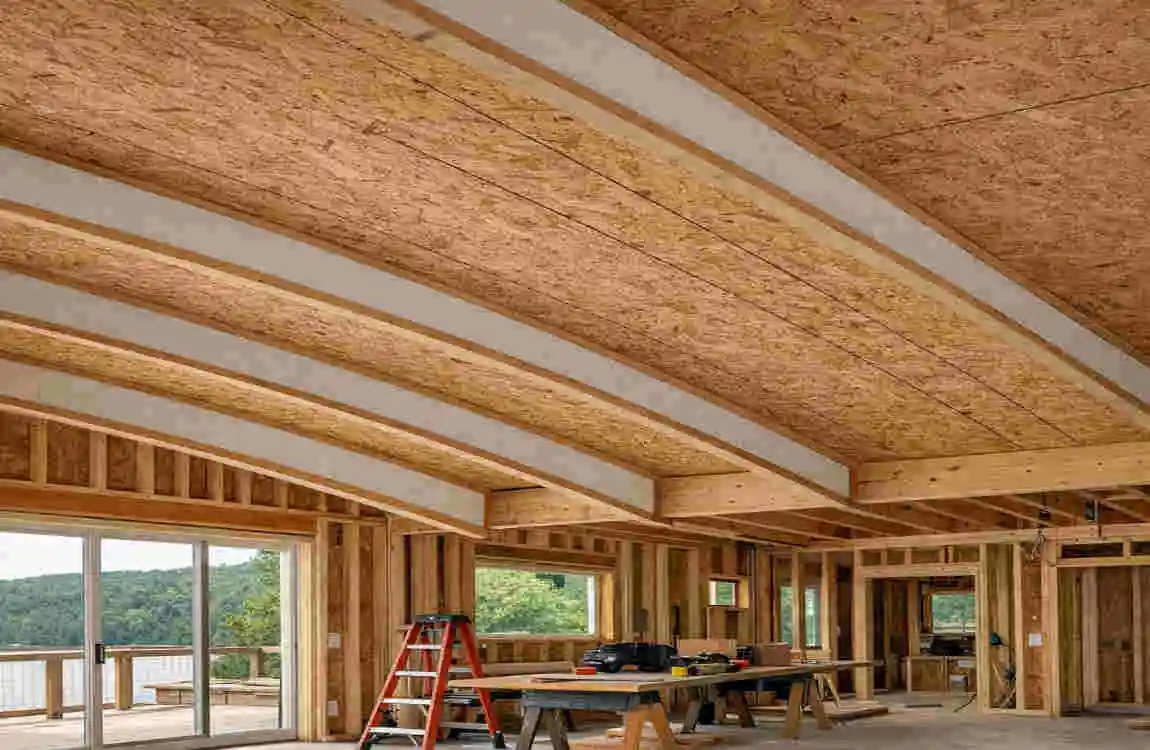
If you are planning a modern home build, perhaps a sleek villa in Lahore or a contemporary cottage, you have likely stared at blueprints and wondered: How far can a SIP roof panel span without needing a wall or a beam to hold it up?
It is the million-dollar question for anyone who loves open-concept living. We all want those soaring, cathedral ceilings without a forest of columns blocking the view. The short answer? A structural insulated panel (SIP) roof can span up to 24 feet unsupported, depending on its thickness and the load it needs to carry.
What Are SIP Roof Panels & Why Span Matters
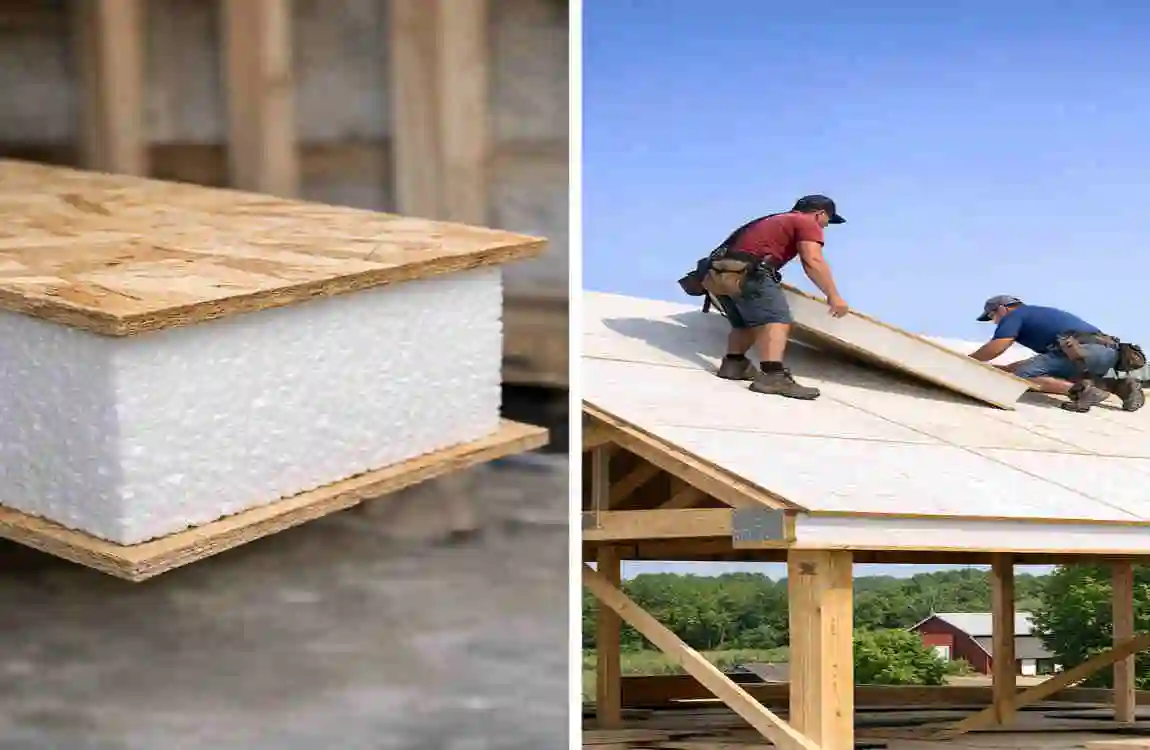
Before we get into the math, let’s make sure we are on the same page about what a SIP actually is. Think of a SIP (Structural Insulated Panel) like an ice cream sandwich.
The Anatomy of a SIP
- The “Cookie”: On the outside, you have two layers of Oriented Strand Board (OSB). This is the structural skin. It provides the tensile and compressive strength.
- The “Ice Cream”: In the middle, there is a thick core of rigid foam insulation, usually Expanded Polystyrene (EPS) or Graphite Polystyrene (GPS).
When you glue these three layers together under massive pressure, you get a composite material that is incredibly strong—much stronger than the individual parts on their own. This is called an “I-beam effect.”
Why Does Span Matter? In traditional construction, your roof is held up by rafters or trusses spaced every 16 or 24 inches. If you want a wide room, those rafters need to be huge, or you need a truss that eats up your attic space.
With SIPs, the panel is the structure. Because they are so strong, they can bridge huge gaps. This leads to:
- Vaulted Ceilings: You automatically get a high, sloping ceiling because you don’t need a flat truss bottom.
- Less Lumber: You are buying less wood and paying for less labor to install it.
- Better Insulation: Because fewer wood studs are breaking up the insulation, your R-value (thermal resistance) skyrockets.
Comparison: SIPs vs. Traditional Trusses
MaterialMax Unsupported Span (Approx)Insulation R-ValueEst. Cost (PKR per sq ft)
SIP Roof Panel 12 – 24 Feet R-30 to R-50+ High Initial / Low Long-term
Traditional Truss 20 – 40 Feet R-19 (with batting) Medium Initial / High Energy Bill
Stick Framing (Rafters) 12 – 16 Feet R-19 Lowest Initial
Factors Affecting How Far SIP Roof Panels Can Span
You might be thinking, “Great, I’ll order the 24-foot panels!” But hold on. The answer to how far a SIP roof panel can span isn’t a single number. It is a calculation based on seven critical variables.
Panel Thickness This is the biggest factor. SIPs come in various thicknesses, ranging from 4 to 12 inches.
- Thicker = Stronger. Just like a thicker branch is harder to snap, a 12-inch panel is much stiffer than a 6-inch panel.
- Thicker = Better Insulation. A 12-inch panel doesn’t just span further; it keeps your home cooler in the intense Lahore summers.
Load Types (Dead vs. Live) Engineers look at two types of weight:
- Dead Load: The weight of the roof itself (shingles, the panel, solar panels, ceiling fans).
- Live Load: Temporary weight. In Pakistan, we don’t worry much about snow (unless you are building in the north). Still, we worry about wind and maintenance loads (people walking on the roof to clean tanks).
- Standard Rule: A typical roof needs to support a live load of 20 pounds per square foot (psf).
Deflection Limits “Deflection” is a fancy word for sagging. All materials sag when weight is applied. The building code sets a limit on the acceptable amount of sag.
- L/360 Standard: This is the most common limit. It means the panel cannot bend more than the span length divided by 360. If it bends more, your drywall ceiling might crack, or your windows might stick.
Edge Connections (Splines) How you connect one panel to the next matters. The “spline” is the connector piece that joins the two foam cores.
- OSB Spline: Standard strength.
- Dimensional Lumber Spline (2x lumber): Adds stiffness.
- Engineered I-Joist Spline: The strongest option for maximum spans.
Slope and Pitch The angle of your roof changes the physics. A steeper roof sheds water and debris more quickly, placing less direct downward pressure on the center of the span than a flat roof.
Seismic and Wind Zones If you are building in Zone 2B (like parts of Punjab), your roof acts as a “diaphragm” that holds the walls together during an earthquake. This might reduce your allowable span to ensure the building stays rigid.
Manufacturer Specifications Every brand is different. One manufacturer’s foam might be slightly denser than another’s. Always check the specific load charts for the brand you are buying.
Maximum Span Limits Revealed
Now, let’s look at the numbers. These are general guidelines based on standard industry load charts for EPS core panels. Always consult a structural engineer for your specific project.
The Breakdown by Thickness
The 6-Inch Panel (The Standard)
- Core Thickness: ~5.5 inches
- Max Unsupported Span: 8 to 12 Feet
- Best For: Small cottages, porches, or roofs supported by purlins (beams) every 10 feet. It offers decent insulation but isn’t a long-span hero.The 8-Inch Panel (The Workhorse)
- Core Thickness: ~7.25 inches
- Max Unsupported Span: 12 to 16 Feet
- Best For: Standard bedrooms and living areas. This is the “sweet spot” for cost-to-performance. In a typical house, this can span from the exterior wall to a central load-bearing wall easily.
The 10-Inch Panel (The Heavy Lifter)
- Core Thickness: ~9.25 inches
- Max Unsupported Span: 16 to 20 Feet
- Best For: Large master suites or garages where you want zero columns. This thickness also provides exceptional insulation (approx R-38).
The 12-Inch Panel (The Beast)
- Core Thickness: ~11.25 inches
- Max Unsupported Span: 20 to 24 Feet
- Best For: Grand living rooms, cathedral ceilings, and commercial spaces.
Data Table: Max Spans Under Load
Panel ThicknessTotal Load (Live + Dead)Max Span (Standard Spline)Max Span (Lumber Spline)
6.50-inch 40 psf 10 ft 13 ft
8.25-inch 40 psf 14 ft 18 ft
10.25-inch 40 psf 18 ft 22 ft
12.25-inch 40 psf 22 ft 24+ ft
Engineering Calculations & Standards
For engineers and math lovers reading this, let’s briefly touch on how these numbers are derived. You don’t just eyeball it; you calculate it.
Let’s break that down into simple terms:
- $w$ (Load): How much weight is on the roof?
- $L$ (Length): This is the span. Notice it is to the power of 4 ($L^4$). This means if you double the span, the sagging increases by 16 times! This is why span limits are so strict.
- $E$ (Modulus of Elasticity): How stiff are the materials?
- $I$ (Moment of Inertia): How is the material shaped? (Thicker panels have a much higher $I$).
The Calculation Process:
- Identify Loads: Use ASCE 7-22 (or the Building Code of Pakistan) to find wind and seismic requirements.
- Check Shear: Ensure the foam core won’t rip apart from the OSB skin under stress.
- Check Deflection: Ensure the panel won’t bow more than the L/360 limit.
- Check Bearing: Ensure the walls under the roof can handle the weight of the roof pressing down on them.
Installation Guide for Optimal Spans
You can buy the world’s strongest 12-inch panel, but if you install it incorrectly, it will fail. Achieving the maximum span requires precision during the build.
Preparation and Alignment The walls supporting the roof must be perfectly straight and square. Because SIPs are prefabricated in a factory, they are cut to exact millimeters. If your concrete foundation is off by an inch, the roof panels won’t fit, and you might have to cut them, compromising their structural integrity.
The Lifting Phase SIPs are heavy. A 24-foot panel can weigh over 500 lbs. You need a crane.
- Safety First: Do not try to manhandle large roof panels.
- Placement: The panel is lifted and set down onto the ridge beam and the wall plate.
The Connection (The Secret Sauce) This is where the strength comes from.
- Spline Insertion: Insert the connecting spline into the foam recesses of the panels.
- Sealant: Apply expanding foam sealant inside the joint. This stops air leakage (vital for energy efficiency) and glues the joint.
- Fastening: Use special SIP screws with large washer heads. You typically drive these screws through the panel’s top skin, through the spline, and into the other side.
- Spacing: Screws are usually spaced every 6 to 12 inches along the joint. Skipping screws weakens the diaphragm and reduces the safe span.
Pros, Cons & Cost Analysis
Is maximizing your span with SIPs worth it?
Pros:
- Speed: You can roof a house in days, not weeks.
- Energy Efficiency: A SIP roof can reduce AC usage in Pakistani summers by up to 40%. The insulation is continuous, unlike truss roofs, which have gaps.
- Aesthetics: You get clean, unobstructed ceiling lines.
Cons:
- Initial Cost: The material cost is higher. Expect to pay a Premium of PKR 20-30 per square foot compared to traditional methods.
- Expertise: You need a crew that knows how to handle SIPs. You can’t just hire a random daily wager.
ROI Reality Check: While the upfront cost is higher, the payback period is usually around 5 years due to energy savings. After year 5, you are essentially making money by saving on electricity.
Real-World Applications in Pakistan
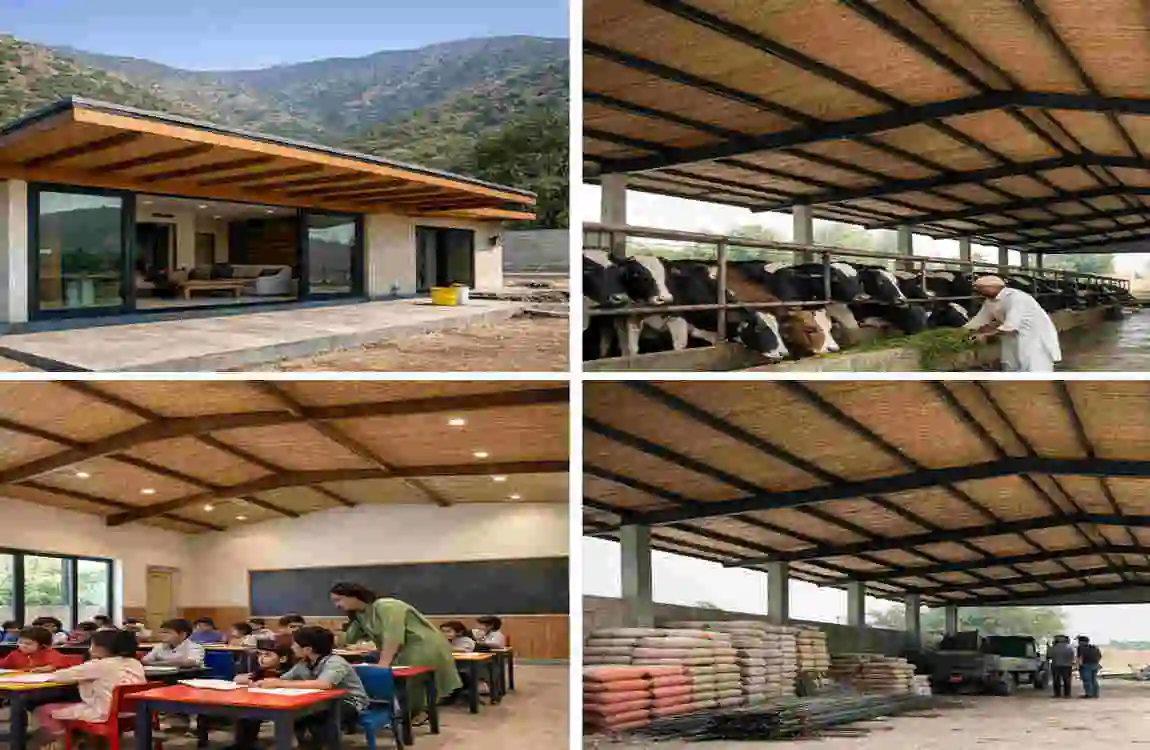
In recent years, we have seen a surge in “Eco-Villas” in Lahore and Islamabad that utilize SIP technology.
Case Study: A modern farmhouse in Bedian, Lahore, used 8-inch SIP roof panels to achieve an 18-foot clear span over the main living area.
- The Result: A stunning vaulted ceiling with no visible beams.
- The Benefit: During the June heatwave (45°C), the attic space remained significantly cooler than that of neighbors with concrete roofs, drastically reducing the load on the inverter AC units.
- Durability: The roof easily handled the heavy monsoon rains without the leakage issues common in flat concrete roofs.
FAQs
How far can a SIP roof panel span without support? Generally, a 12-inch thick SIP panel can span up to 24 feet without intermediate support. However, for standard residential thicknesses like 8 inches, the limit is closer to 16 feet.
What affects SIP roof panel spans the most? The panel thickness and the type of spline (connector) used are the two biggest factors. A lumber spline allows for a longer span than a standard OSB spline.
What is the max SIP span for residential roofs in seismic areas? In seismic zones (like Zone 2B in Pakistan), spans may need to be reduced, or fastener patterns tightened to ensure the roof acts as a rigid diaphragm to hold the walls together during a tremor.
SIP vs. I-joist spans: Which is better? I-joists can technically span longer distances (30+ feet) more cheaply than SIPs. However, I-joists do not provide insulation. When you factor in the cost of adding spray foam or batting to an I-joist roof, SIPs often become the better value for spans under 24 feet.
