

Have you ever walked into a dark, cozy, enclosed room in your basement or attic and thought, “This would make the absolute perfect guest room”? It is incredibly tempting to throw a comfortable mattress and a nice rug into a quiet, secluded space. But before you start moving your furniture and painting the walls, you need to stop and ask one very important question: do bedrooms have to have windows?
While you might think that window requirements are just about getting a nice view of your backyard or letting in some morning sunlight, the reality is much more serious. Building codes mandate windows primarily for your safety. Specifically, they are required for fire safety and emergency escapes.
In the construction and real estate world, you will often hear professionals talk about building standards such as the International Residential Code (IRC) and the International Building Code (IBC). These rulebooks dictate exactly what makes a house safe to live in. However, the exact requirements for bedroom windows can vary depending on where you live. Your local city or county might have slightly different rules than a town just one state over.
Brief History of Bedroom Window Requirements
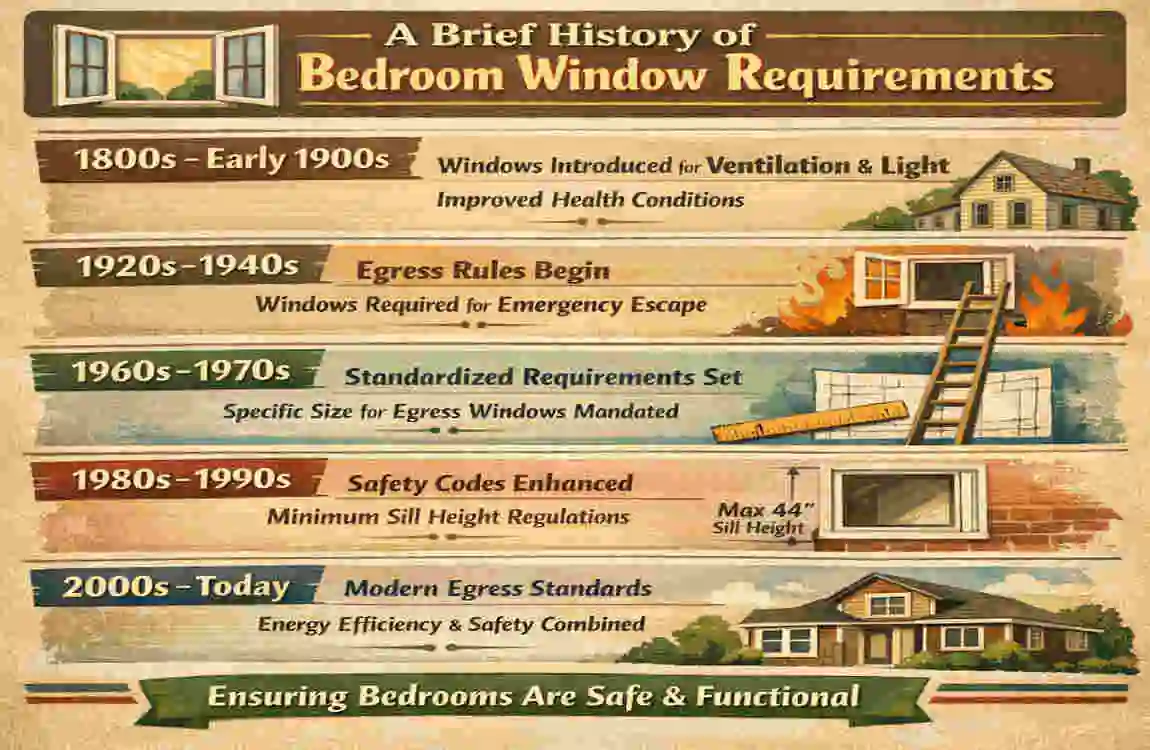
To truly understand why building inspectors are so strict about bedroom windows, we need to take a quick step back in time. Building codes did not just appear out of thin air; they were written in response to real-world events.
If you look at homes built before the 1970s, you might notice something terrifying. Many older homes feature tiny, high-up windows in the bedrooms, especially in basements or upper-level dormers. Builders designed these windows purely for a tiny bit of ventilation or to save on glass costs. They never considered how a person might actually use that window during an emergency.
Tragically, during the 1970s, a series of devastating residential fires swept across the country. Because the bedroom windows were too small to climb through or placed too high on the wall to reach, many people found themselves completely trapped. When the primary hallway exit was blocked by smoke or flames, families had no secondary way out.
In response to these heartbreaking events, building organizations radically updated the fire codes. This is when the concept of the “egress window” became a mandatory standard in the modern International Residential Code (specifically section R310). The word “egress” means a path out. The law shifted from viewing windows as decorative features to viewing them as critical, life-saving escape hatches.
Legal Requirements: Do Bedrooms Have to Have Windows by Code?
Now that we know the history, let us get into the exact rules you need to follow today. If you are planning a house renovation, you must understand the legal framework. So, do bedrooms have to have windows by code? Yes, and the rules are incredibly specific.
Federal vs. Local Building Codes
First, it is important to understand how building laws work in the United States. We actually do not have a single national federal law that governs how you build your house. Instead, we have a model rulebook called the International Residential Code (IRC).
Under IRC Section R310, every sleeping room must have at least one operable emergency escape and rescue opening. Most of the time, this opening is a window. Sometimes it’s an exterior door that leads directly outside.
While the IRC writes the rules, your local town, city, or county government actually enforces them. Local governments adopt the IRC, but they can tweak it. For example, states like California often add even stricter rules on top of the IRC to deal with energy efficiency and earthquake safety. Always check with your local permit office before making assumptions.
Key Egress Window Specs Table
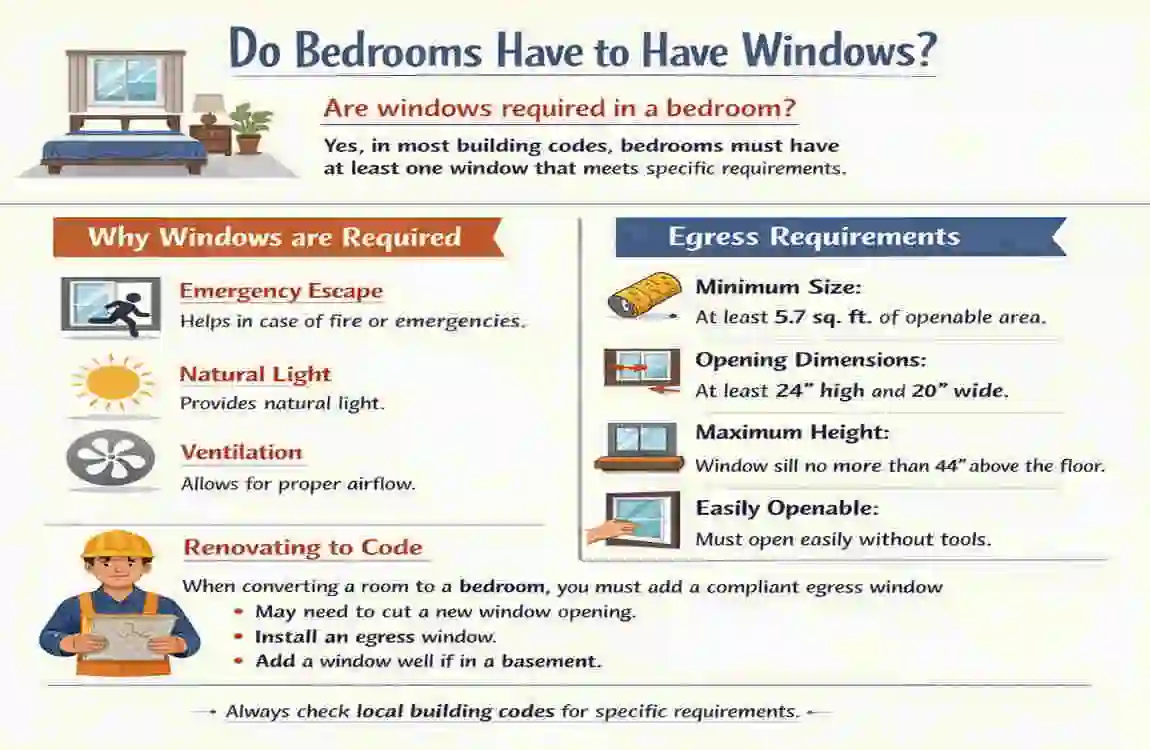
If you want to know if your current bedroom window is legal, you need to grab a tape measure. Building inspectors do not just look at a window and guess if it is big enough. They follow strict mathematical guidelines. Here is a breakdown of the exact egress window code measurements you need to meet:
Requirement Minimum Standard Why It Matters
Openable Area 5.7 sq ft (ground floors allow 5 sq ft). Provides enough physical space for a firefighter with an oxygen tank to climb in, and for you to easily escape.
Width & Height: At least 20″ wide, and at least 24″ high. Ensures the opening is shaped practically for a human body to pass through without getting stuck.
Sill Height: Maximum of 44″ from the finished floor. Guarantees the window is low enough for children, older people, or a panicked adult to reach without a ladder.
Bars or Grilles Must have quick-release mechanisms inside. security bars cannot require a key or special tool to open from the inside during a frantic emergency.
Ventilation & Light Rules
Safety is the priority, but comfort and health come in at a close second. The building code also dictates how much light and air your bedroom receives.
According to standard rules, the “glazed area” of your bedroom window must equal at least 8% of the room’s total floor square footage. (Don’t let the technical term confuse you; “glazed area” is just the builder’s word for the actual glass pane). So, if your bedroom is 100 square feet, you need at least 8 square feet of glass to let in natural sunlight.
Additionally, you need an openable window area equal to at least 4% of the room’s floor space. This ensures you can open the window and cycle out stale air. The code generally expects that an open window can provide adequate fresh air if left open for about 45 minutes every hour.
Exceptions: When Bedrooms Don’t Need Windows
We just spent a lot of time telling you how strict the rules are. But in the world of real estate and construction, there is almost always an exception to the rule. Are there times when a bedroom doesn’t need a traditional window? Yes, but these situations are highly specific and tightly regulated.
Basement Bedrooms
Basements are the most common places homeowners try to sneak in an extra, illegal bedroom. If your basement is entirely underground, adding a window means digging a massive hole in your yard and installing a corrugated window well. It is expensive and messy work.
However, you might catch a break if you have a walk-out basement. If your basement bedroom is situated on the ground floor and has a standard exterior door that leads directly to your backyard, you might not need a traditional window. The exterior door perfectly satisfies the emergency egress requirement. Just remember, if the bedroom is tucked away in an upper or inner section of the basement without direct yard access, you still have to install that egress window well.
Tiny Homes and ADUs
The housing market has changed drastically, and by 2026, Tiny Homes and Accessory Dwelling Units (ADUs) will be more popular than ever. Because these structures are so small, traditional building codes often struggle to apply to them.
The IRC recently introduced special exemptions for tiny houses that are under 400 square feet (and particularly those under 200 square feet). In some incredibly compact designs, a traditional 5.7-square-foot egress window would take up an entire wall! In these specific cases, inspectors might allow for smaller roof windows or specialized exit hatches. However, you must heavily research your local zoning laws, as many towns still treat tiny homes exactly like traditional houses.
Historic Houses
What happens if you buy a stunning, 200-year-old historic home? The windows in these homes were built long before the modern egress codes existed. If you cut a larger hole in the exterior to install a modern vinyl window, you might destroy the historical integrity of the architecture.
In these cases, the local historical society and the building department usually work together to grant a waiver. You won’t have to rip out the historic windows, but you will have to make some compromises. The city will likely require you to install highly advanced, interconnected smoke detectors and, in some cases, a residential fire sprinkler system to compensate for the lack of a proper escape route.
Health and Safety Benefits of Bedroom Windows
We focus so heavily on the law that it is easy to forget why these laws exist in the first place. Beyond just passing an inspection and avoiding a fine, having a properly sized window in your bedroom provides incredible, life-changing benefits for your mind and body.
The Magic of Natural Light and Fresh Air
Humans are not meant to live in dark boxes. Our bodies are deeply connected to the sun. When natural light floods into your bedroom in the morning, it triggers your circadian rhythm. This internal biological clock tells your brain to stop producing melatonin (the sleep hormone) and start waking you up. Without a window, your body gets confused. People who sleep in windowless rooms often report feeling sluggish, depressed, and chronically fatigued.
Furthermore, let’s talk about the air you breathe. When you sleep in a closed room for 8 hours, you constantly exhale carbon dioxide (CO2). In a sealed, windowless room, CO2 builds up rapidly. High levels of CO2 lead to morning headaches, poor sleep quality, and a general feeling of grogginess. Opening a window lets you flush out that stale air.
Proper ventilation also drastically reduces the chances of toxic mold growing in your home. Bedrooms create a surprising amount of humidity just from our breath and body heat. A window lets that trapped moisture escape before it can settle into your drywall.
The Fire Safety Reality
We cannot stress the importance of fire safety enough. When a fire breaks out in a home at night, the hallways typically fill with thick, blinding, toxic smoke long before the flames reach the bedrooms. You cannot simply walk out your bedroom door and head for the front porch.
According to safety experts, a vast majority of successful home fire escapes—some estimates suggest up to 80%—happen through secondary exits, such as bedroom windows. A compliant egress window is quite literally the difference between life and death.
Comparison Table: Window vs. Windowless Bedroom
To make the contrast crystal clear, let’s look at how a legal bedroom compares to an illegal, windowless space:
Feature Legal Bedroom (With Windows)Illegal Room (Without Windows)
Air Quality Excellent. Natural cross-breeze prevents mold. Poor. Requires expensive mechanical ventilation systems to remove CO2.
Resale Value High. Adds roughly 5-10% to total home value. Lower appeal. It cannot legally be listed or appraised as a bedroom.
Code Compliance Easy. Passes home inspections effortlessly. Risky. Leads to failed inspections, fines, and costly forced upgrades.
Mental Health Positive. Natural sunlight boosts serotonin levels. Negative. Increases feelings of claustrophobia and disrupts sleep cycles.
Windowless Bedrooms: Creative Design Solutions
Let us say you have a unique situation. You may live in a dense urban environment, or you are converting an old industrial warehouse into an apartment. You have a space that absolutely must function as a sleeping area, but it lacks traditional exterior walls for standard windows. What do you do?
If you are forced to work with a tricky layout, some highly creative design solutions can keep you legally compliant and mentally sane.
Egress Alternatives: The Exterior Door
As we mentioned earlier, the law requires an “opening,” not necessarily a glass window. If your room sits against an exterior wall but you don’t want a window, you can install a solid exterior door. This satisfies the fire escape rules perfectly. This is very popular in modern, minimalist homes that feature private, walled-off courtyard gardens directly off the main bedroom.
Luxe Hacks: Bringing in the Light
If you have secured a legal egress route (like a door) but the room still feels like a dark cave, you need to trick the eye. You can pull natural light down from the roof! Installing large skylights or tubular daylighting devices (light tubes) can funnel incredible amounts of sunshine directly into a windowless interior room. While a skylight high up on a vaulted ceiling does not count as an egress exit (because you cannot reach it), it completely solves the psychological need for daylight.
Additionally, interior designers rely heavily on strategically placed large mirrors. By placing a wall-sized mirror opposite a hallway door, you can catch the light from other rooms and bounce it deep into your dark sleeping space.
Case Study: Modern Loft Conversions
Consider the trendy warehouse loft conversions happening in cities like New York and Chicago. These massive, deep buildings often only have windows on the front and back walls. To create bedrooms in the deep center of the building, architects use “borrowed light.” They build the bedroom walls using frosted glass blocks or install interior windows that look out into the well-lit main living room. Then, to satisfy the fire code, they ensure the building has a highly advanced, commercial-grade sprinkler system that grants them a special zoning waiver.
Cost to Add Windows to Your House
Okay, let’s talk numbers. If you currently have an illegal windowless room and want to bring it up to code, how much will that cost you?
Adding a window to an existing wall is a major construction project. It requires cutting through drywall, insulation, exterior siding, and sometimes even structural studs or concrete foundation walls.
The Breakdown of Expenses
If you are installing a standard vinyl egress window in a typical above-ground wood-framed wall, you can expect to pay between $500 and $1,500 installed. Vinyl is incredibly durable, energy-efficient, and budget-friendly.
However, the price jumps significantly based on a few key factors:
- The Frame Material: Upgrading from basic vinyl to high-end fiberglass or custom-stained wood frames will easily double your materials cost.
- The Wall Material: Cutting a hole through vinyl siding is easy. Cutting a hole through solid brick, stone veneer, or a poured concrete basement foundation requires heavy machinery and specialized diamond-blade saws.
- Labor Costs: Professional window installers and carpenters typically charge between $200 and $500 per hour for this kind of structural modification, or they will quote a flat rate for the entire project.
The Amazing Return on Investment (ROI)
Before you panic about the price, you need to look at the big picture. Adding a legal window is not just an expense; it is a massive investment.
By adding an egress window, you are officially turning a “bonus room” into a legally recognized bedroom. When it comes time to sell your house, a 4-bedroom home commands a vastly higher asking price than a 3-bedroom home with a dark office. Real estate data consistently shows that homeowners recoup roughly 70% to 80% of the window installation cost at the time of sale. Plus, you get the peace of mind knowing your family is safe!
Step-by-Step: Renovating for Bedroom Window Compliance
Are you ready to stop wondering, “Do bedrooms have to have windows?” and actually start making your home compliant? Upgrading your home does not have to be a nightmare if you follow a logical, step-by-step process. Here is how you tackle this renovation the right way:
Check Your Local Code at the Permit Office
Never assume your town follows the basic national rules. Before you buy anything, take a trip down to your local city hall or building department. Explain your project to the permit office and ask for their specific egress window code handouts. They will tell you exactly which sizes they require and which permits you need to pull.
Measure Your Space Carefully
Go back to the room and grab your tape measure. Use the IRC table we provided earlier in this article. Check where the wall studs are located using a stud finder. Ensure you have enough wall space to fit a window with a 5.7-square-foot clear opening, while keeping the bottom sill at least 44 inches above the floor.
Hire a Qualified Contractor
Do not try to cut a massive hole in your house by yourself unless you are an experienced builder. You could accidentally cut through electrical wires, plumbing pipes, or crucial load-bearing studs that hold up your roof. Get at least three written quotes from licensed, bonded, and insured window installation contractors. Make sure their quote specifically states that they will guarantee the window complies with the local egress code.
Schedule the Final Inspection
Once the contractor finishes the job, you must have the city building inspector come to your house to sign off on the work. They will physically open the window and measure the opening to ensure you followed the law. Once they approve it, congratulations! You now have a legally recognized, safe, and beautifully bright bedroom.
State-by-State Bedroom Window Rules Quick Guide
Because the United States is so large and geographically diverse, local building codes adapt to deal with local natural disasters and climates. Here is a quick look at how bedroom window rules shift depending on where you live:
California and Florida (The Strict States): If you live in California, you have to deal with wildfires and massive earthquakes. Therefore, the state requires specialized safety glazing and strict energy-efficiency coatings. In Florida, the threat of hurricanes means your bedroom windows must be constructed with impact-resistant shatterproof glass, or you must have specialized storm shutters installed on the exterior to protect the egress route from flying debris.
Texas and New York (The Standard States): In states like Texas, you will mostly find standard IRC regulations. The focus there is ensuring you have proper ventilation to help combat the intense summer heat. In New York, particularly in dense urban areas like New York city, the rules are highly complex. Because houses are built right up against each other, you often cannot put a window on a side wall. Furthermore, upper-story bedrooms in cities rely heavily on external metal fire escapes rather than standard window drops.
Always cross-reference your project with your specific state authority. You can find more detailed state-by-state breakdowns in our Regional House Building Standards Guide.
FAQs: Do Bedrooms Have to Have Windows?
We know this is a lot of technical information to absorb. To make things easy, we have compiled the most common questions we get from homeowners just like you.
Do bedrooms have to have windows in every house? For any new construction or modern renovation, yes. The building code strictly requires an emergency escape and rescue opening in every room used for sleeping.
Can a bonus room be a windowless bedroom? No. If you have a room without a window, a real estate agent and an appraiser will legally classify it as a “bonus room,” an “office,” or a “storage space.” It cannot be legally marketed as a bedroom unless you add a compliant egress window.
What if my window is just an inch too small? Building inspectors are notoriously strict. If your window requires a 5.7-square-foot opening and yours is 5.5 square feet, it will fail inspection. You will have to replace the entire window.
Can a skylight count as my bedroom window? Usually, no. An egress window must have a sill height no higher than 44 inches from the floor so you can climb out. Skylights are almost always placed on the ceiling, making them useless for a fire escape.
Does a closet matter for a bedroom? Interestingly, the International Residential Code does not mandate a closet for a room to be considered a bedroom! While real estate agents prefer closets, the building code only cares about safety (the window) and minimum floor space (usually at least 70 square feet).
Are basement window wells required? Yes. If your basement bedroom window is below ground level, you must dig a window well. The well must be at least 9 square feet in area to allow a person enough room to climb out and escape to the yard.
Can I put a window air conditioner in my only bedroom window? Technically, this violates the fire code! If your bedroom has only one window and you block it with a heavy AC unit, you have eliminated your only emergency escape route. You should always ensure you have a secondary, unblocked window if you plan to install a window AC unit.
