
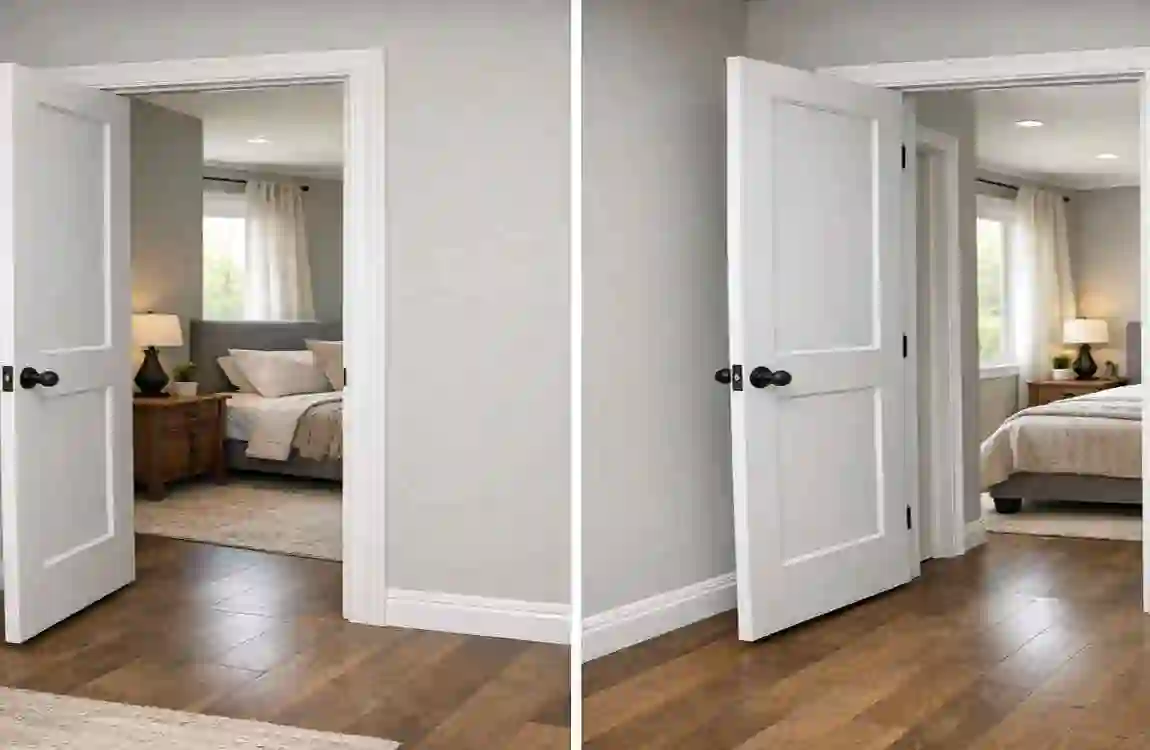
Imagine you are in the middle of renovating your absolute dream home. You have spent weeks agonizing over the perfect shade of calming blue paint for the walls. You have carefully selected the warmest, most inviting hardwood floors. You have even mapped out exactly where your cozy new bed will go. But just as your contractor starts framing the walls, they turn to you and ask a question that stops you in your tracks.
At first glance, this is a tiny, insignificant detail. You might even be tempted to tell your builder to do whatever is easiest. However, your bedroom door swing direction is actually a massive home design decision. It directly impacts the daily traffic flow of your hallways, the aesthetic appeal of your home, and even the overall property value.
Think about it. The way a door swings dictates where you can place your furniture, how private your room feels when you leave the door cracked, and how safely your family can navigate the house during an emergency. Getting this detail wrong can result in years of frustration, bumped elbows, and blocked light switches.
Did you know that in standard home construction, nearly 90% of bedrooms use an inward swing? But just because it is the standard does not mean it is the absolute best choice for your specific floor plan. Depending on your layout, choosing the right swing direction can help you magically gain 20% to 30% more usable floor space!
Pros and Cons of Inward-Opening Bedroom Doors
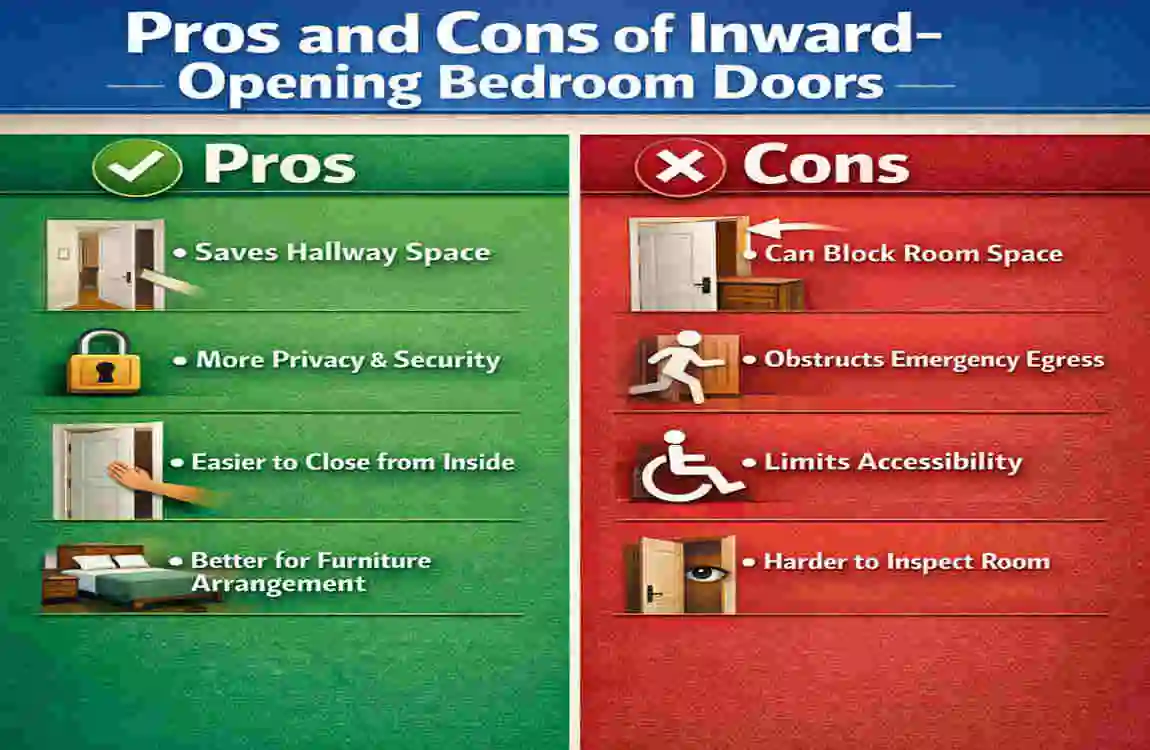
When you walk into a traditional house and head toward a bedroom, you will almost always push the door inward to enter. This is the tried-and-true standard of the architectural world. But why is this the default? Let’s dive deep into the specific advantages and the hidden drawbacks of having your bedroom doors swing into your room.
Why Inward Swing Wins for Privacy
Your bedroom is your ultimate sanctuary. It is the one place in the house where you expect total privacy to relax, change clothes, and unwind. This is exactly where the inward swing truly shines.
When you push an inward-swinging door open, it acts as a physical shield. Imagine you are standing in your bedroom, and someone walks down the hallway. If the door is cracked open just a few inches, the angle completely blocks the view from the hallway into the center of the room. The door protects your privacy, allowing you to peek out without exposing your entire personal space to passersby. This is incredibly ideal for busy family homes where kids and guests are constantly roaming the halls.
Furthermore, inward-swinging doors offer excellent sound insulation. Because the door frame features a specific “stop” molding on the inside, an inward-swinging door rests tightly against it when closed. This tight seal helps block out the loud noises of televisions and chatter from the living room.
Finally, let’s talk about child safety and personal security. With an inward-swinging door, the hinges are located entirely inside the bedroom. This means nobody on the outside can easily pop the hinge pins out to remove the door. Additionally, if you need to lock yourself in for privacy, the standard locking mechanisms are much easier to manage and secure from the inside.
Space and Aesthetic Advantages
Beyond privacy, inward-opening doors offer some brilliant aesthetic benefits. When you walk down your hallway, you want the space to look clean, smooth, and uncluttered. Because an inward-swinging door keeps its hinges hidden inside the bedroom, your hallway walls look incredibly sleek and uninterrupted.
Inside the bedroom, an inward swing gives you predictable furniture placement flexibility. In a well-designed room, the door is placed near a corner. When you push the door open, it immediately swings flat and hugs the nearest wall.
By hugging the wall, the door stays completely out of your way. It does not jut out into the middle of the room, leaving the center of your floor plan wide open. You can easily walk in, drop your bags, and move toward your bed or closet without having to do an awkward dance around a heavy wooden slab.
Drawbacks: Floor Space and Path Interference
Of course, no design choice is entirely perfect. The biggest drawback of an inward-swinging door is the “dead zone” it creates inside your room.
When a door swings inward, it requires a clear, unobstructed arc to open and close. You absolutely cannot place any furniture within this arc. In a standard-sized bedroom, this swing path consumes roughly 10 square feet of precious floor space. In a massive main suite, you might not even notice this loss. But in a tiny, cramped guest room, losing 10 square feet can mean the difference between fitting a queen-sized bed or being forced to downgrade to a twin.
Additionally, there are minor tripping hazards to consider. If you leave your bedroom door halfway open at night, you might accidentally walk into the edge of it in the dark when you get up for a glass of water. If your room is already tight on space, an inward-swinging door can sometimes feel like it is trapping you in.
Pros and Cons of Outward-Opening Bedroom Doors
Now that we understand the standard inward swing, let’s flip the script. What happens if you grab the handle and pull the bedroom door out into the hallway? While this is much less common in residential homes, the outward-swinging door is rapidly gaining popularity in modern 2026 house designs. Here is why you should break the rules.
Space-Saving Hero for Tight Rooms
If you live in an urban apartment, a cozy cottage, or you are designing a tiny home, every single inch of floor space matters. This is where the outward-opening door becomes an absolute space-saving hero.
Because the door swings completely out into the hallway, it requires absolutely zero floor space inside the bedroom itself. You regain that 10-square-foot “dead zone” instantly! This allows you to push a desk right up next to the doorway, install deeper closets, or fit a larger bed into a tiny room without worrying about the door banging into your furniture.
This design is also incredibly popular for tight en-suite bathrooms or small walk-in closets attached to the bedroom. By having those doors swing outward into the main bedroom, you maximize the usable space in those tiny utility rooms. In fact, many modern building codes favor outward-swinging doors in very small spaces to prevent people from getting trapped if they fall and block the door from opening inward.
Enhanced Safety and Airflow
When you think about emergencies, an outward-swinging door is actually the safest option for quickly exiting a room. Imagine a scenario where you need to leave your bedroom in a rush in the middle of the night. It is much more natural and much faster to push a door open as you run forward than it is to stop, pull the door toward you, step back, and then exit.
This “push to exit” logic is exactly why commercial buildings, schools, and hospitals are legally required to use outward-swinging doors for fire safety. While residential building codes for bedrooms are much more relaxed, adopting this commercial safety feature in your home provides excellent peace of mind.
Additionally, outward-swinging doors often allow for much better airflow management if you like to keep your windows open to catch a cross-breeze. An outward-swinging door can be propped open into the hallway to help channel that fresh air throughout the entire house.
Downsides: Privacy Loss and Hallway Clutter
So, why doesn’t everyone use outward-swinging doors? The downsides are highly visible the moment you step into the hallway.
The biggest negative is the massive loss of privacy. When you open an outward-swinging door, the door swings away from the room, instantly exposing the entire bedroom to anyone standing in the hallway. You lose that protective visual shield that an inward door provides.
Furthermore, outward doors create serious hallway clutter and potential collision hazards. If your bedroom door opens into a narrow, busy hallway, you risk violently hitting a family member who happens to be walking by at the exact moment you push the door open. If you have multiple bedrooms located close together in a single corridor, having all those doors swing outward creates a chaotic, overlapping mess of wooden panels blocking the path.
Finally, the hinges on an outward-swinging door are fully exposed to the hallway. While this is not a major security threat in a private home, it disrupts the smooth aesthetic of your hallway walls. It gives your interior a slightly more industrial look.
Key Factors to Decide: Should Bedroom Doors Open In or Out?
By now, you can see that both options have fantastic benefits and frustrating drawbacks. So, how do you make the final call for your own home?
To help you decide whether your bedroom doors should open in or out, you need to analyze your specific living situation. We have created a simple, easy-to-read decision matrix to guide you.
Factor Inward Swing is Best For. Outward Swing is Best For
Room Size : Larger bedrooms (Over 120 sq ft) , Small, tight spaces (Under 100 sq ft)
Privacy Needs High (Master suites, teen rooms) Low (Guest rooms, home offices)
Hallway Traffic Low-use, quiet corridors Wide, open family areas
Building Codes Standard residential interiors Emergency exits, tiny en-suites
Home Style Traditional, classic designs Modern minimalist, urban lofts
Let’s break down these critical factors in greater detail so you can apply them to your blueprints.
Analyzing Your Room Dimensions
The physical size of your bedroom is the number one determining factor. Grab a tape measure and evaluate your doorway. A standard interior door is usually 30 to 36 inches wide. This means you need a clear, unobstructed semi-circle (the swing arc) with a radius of at least 36 inches to open the door.
If your bedroom is spacious—say, 12 feet by 15 feet—sacrificing that 36-inch arc in the corner of the room is barely noticeable. Go with the inward swing.
However, if you are designing a compact 9-foot-by-9-foot child’s room, that 36-inch arc takes up a large percentage of your usable floor space. If you cannot fit a bed, a dresser, and a small desk in the room because the door is in the way, it is absolutely time to consider an outward swing.
Factoring in Your Lifestyle and Hallway Traffic
You must think about how your family actually lives and moves through the house. Do you have young, energetic kids who constantly run down the hallways chasing the family dog? If so, an outward-swinging door is a recipe for disaster. You are practically guaranteed to push the door open right into a running child. In a busy household, keep the doors swinging inward to keep the hallways clear and safe.
On the other hand, if you live alone or if your bedroom opens into a massive, wide-open loft rather than a narrow corridor, hallway collisions are not a concern. You can safely utilize an outward swing to maximize your bedroom space.
Building Codes and Resale Value
You should always check your local residential building codes before making structural changes. In almost all municipalities, standard interior bedroom doors are perfectly legal to swing inward. However, some local codes have specific rules about doors located near the top of a staircase. You never want a door to swing outward directly over a stairwell, as it creates a severe fall hazard.
Finally, consider your resale value. Because 90% of homes use inward-swinging doors, future buyers expect to see them. Inward doors give a home a traditional, luxurious, and private feel. Unless the bedroom is incredibly small, sticking with the standard inward swing generally protects your home’s perceived value on the real estate market.
Expert Recommendations and House Design Trends
The world of interior design is constantly evolving. As we move deeper into 2026, architects and home builders are rethinking how we interact with our spaces. Let’s look at what industry experts recommend for modern homes.
Top Architects’ Picks
According to recent design surveys across top architectural firms, roughly 70% of new builds still favor the classic inward swing for primary bedrooms. Experts agree that the psychological benefit of stepping into a cozy, private retreat cannot be beaten.
However, architects are getting incredibly clever with how they handle small spaces. Instead of dealing with the drawbacks of outward swings in tight hallways, the biggest trend for 2026 is the rise of the hybrid pocket door and the modern bi-fold door.
If a homeowner asks, “Should bedroom doors open in or out?” many architects now reply, “Neither!” Pocket doors slide directly into a hidden cavity within the wall, taking up absolutely no floor space in the bedroom or the hallway. While they require more advanced construction to build the wall cavity, they are the ultimate luxury solution for saving space.
Cost Breakdown and ROI
If you are planning a renovation, you need to know the numbers. Installing a standard inward-swinging door is incredibly cost-effective. Because the frames and hardware are mass-produced for this exact setup, you can expect a professional installation to cost between $200 and $500 per door, including materials.
Switching to an outward-swinging door can sometimes be slightly more expensive, ranging from $300 to $700. Why the price bump? Outward doors often require specialized hinges, different security strike plates, and custom trim work to make the exposed hardware look attractive in the hallway.
What about your Return on Investment (ROI)? Proper door swing optimization is a small detail. Still, real estate agents note that fixing awkward floor plans by correcting door swings can add an estimated 2% to 5% to your home’s overall value. Buyers love a house that “flows” well!
Retrofit Tips for DIYers
If you already have inward-swinging doors but want to reverse them to save space, you can absolutely do it yourself! However, our experts have a few warnings.
To reverse a swing, you cannot simply flip the door around. You have to carefully remove the entire door frame casing, chisel out new mortises (the carved indentations) for the hinges on the opposite side of the jamb, and relocate the strike plate for the latch. It is a highly satisfying weekend project, but you must take your time to ensure the door remains perfectly plumb and level.
Installation Best Practices for Optimal Privacy & Space
Whether you hire a professional contractor or decide to tackle the job yourself, installing a door correctly is crucial for it to function smoothly for decades. Here is your step-by-step guide and best practices for installing your perfect bedroom door.
Step-by-Step Installation Guide
Measure the Swing Arc Meticulously. Before you buy anything, grab some blue painter’s tape. Tape out the exact arc the door will take on your floor. Ensure you have at least 36 inches of clearance. Check that the door will not hit the bed or the closet, or block a window, when fully opened.
Choose High-Quality Hardware. Do not cheap out on your hinges! In 2026, luxury homes are utilizing heavy-duty, soft-close hinges. These incredible mechanisms catch the door just before it slams shut, gently and silently pulling it into the frame. This is a game-changer for preserving a quiet, peaceful bedroom environment.
Align with the House Flow (Right-Hand vs. Left-Hand Swing) You have to decide which side the hinges will go on. The golden rule of house design is that a door should always open against the nearest adjacent wall. If the wall is on the right, you need a right-hand swing. This ensures the door hugs the wall and does not open awkwardly into the middle of the room.
The Ultimate Safety and Function Checklist
Before you hang that heavy wooden slab, run through this quick checklist:
- Check the light switches: This is the most common DIY mistake! Ensure the door does not swing open and block the wall light switch. You should be able to reach into the room and turn on the light before fully entering.
- Install door stops: Never let a door handle violently smash into your drywall. Always install a baseboard door stop or a hinge-pin stop to protect your expensive paint job.
- Evaluate the floor gap: Ensure there is a gap of at least half an inch at the bottom of the door. This ensures proper HVAC airflow when the door is closed.
Real-Home Case Studies
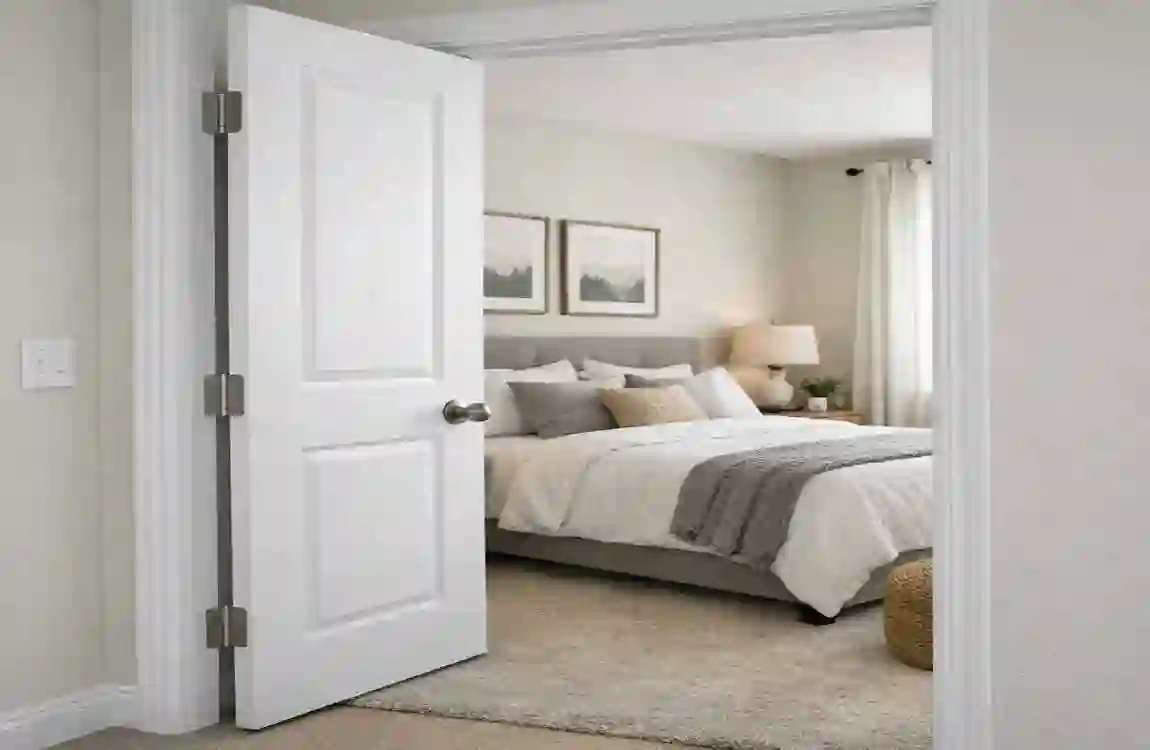
Sometimes, the best way to understand these design concepts is to see how they play out in the real world. Let’s look at two very different homes and how they solved their door-swing dilemmas.
During a minor renovation, they decided to switch the door to an outward swing, opening into their wide, spacious upstairs landing. The result? They instantly gained nearly 15% more usable floor space inside the bedroom! This allowed them to set up a dedicated play corner and a small reading desk that would not fit before. Because the hallway was wide enough to handle the outward swing, it was a massive success.
The Urban Apartment. Conversely, a young professional living in a tight, modern city apartment faced a different issue. Her bedroom was small, but she had a fantastic walk-in closet located just behind the bedroom door.
She briefly considered an outward-swinging bedroom door to make her bedroom feel larger. However, her hallway was so narrow that an outward door would completely block access to the bathroom across the hall. She chose to keep the inward swing. By installing a high-quality door stop, she ensured the bedroom door stopped just short of the closet, preserving access to her wardrobe while keeping the narrow hallway clear.
FAQ: Bedroom Door Swing Questions Answered
We know this topic sparks a lot of debate among homeowners! Let’s answer some of the most frequently asked questions about bedroom door swings.
Should bedroom doors open in or out by code? In standard residential homes, there is no strict universal building code that forces a bedroom door to open inward. However, standard convention dictates inward swings for privacy. Outward swings are strictly mandated by code in commercial buildings for public fire safety. Still, you have the freedom to choose what works best for you in your private home.
Can I change my door direction easily? Yes, but it takes a bit of elbow grease! A handy DIYer with the right tools (a chisel, drill, and level) can reverse a door swing in about 2 to 4 hours. You will need to patch the old hinge cutouts and drill new ones on the opposite side of the door frame. If you are not confident in your carpentry skills, hiring a handyperson is highly recommended.
What is the best choice for renters? If you are renting your home or apartment, you absolutely must keep the inward-swinging door that is currently installed. Reversing a door requires altering the physical door frame, moving the strike plates, and patching wood. Doing this without your landlord’s permission will almost certainly result in the loss of your security deposit due to damage to the walls and frames.
What are the modern door trends? The biggest trends this year are all about saving space without sacrificing aesthetics. If you are torn between inward- and outward-swinging doors, consider a modern bi-fold hybrid door. These doors fold perfectly in half as they open, requiring only 50% of the swing space of a traditional door. They are sleek, modern, and incredibly functional for tight bedrooms!
