
Have you ever walked into an empty room in a new house and wondered, exactly how big is a bedroom supposed to be? Picture this: you are touring your potential dream home or sitting down with an architect to draw up floor plans. You look at a square on the paper and try to imagine if your giant king-sized bed, your favorite reading chair, and your massive wardrobe will actually fit inside without feeling like a cramped closet.
Getting your bedroom size right is about so much more than just having enough floor space to walk around. The dimensions of your sleeping quarters directly impact your daily comfort, your home’s future resale value, and even your compliance with strict local building codes. If you make a room too small, it feels suffocating. If you make it too large without a clear purpose, it can feel cold and uninviting.
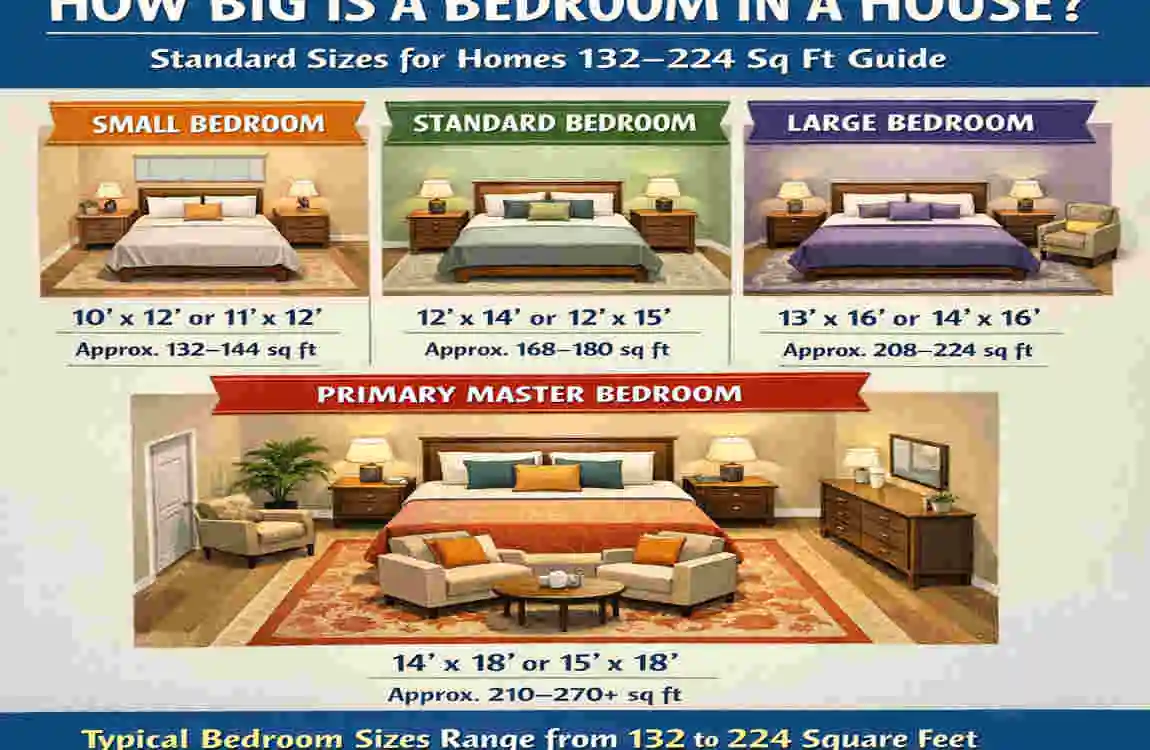
Generally speaking, standard modern bedrooms fall into a specific range. A comfortable guest room often hovers around 132 square feet. In comparison, a luxurious main suite easily stretches to 224 square feet or more. But what exactly is the standard bedroom size in a house for your specific needs? And how do regional differences change these numbers?
| Bedroom Type | Dimensions (ft) | Square Feet | Best For |
|---|---|---|---|
| Minimum/Guest | 10 x 10 | 100 | Single bed, basic use |
| Small/Child’s | 10 x 12 | 120 | Twin/Full bed |
| Standard/Secondary | 11 x 12 – 12 x 12 | 132-144 | Queen bed + furniture |
| Medium | 12 x 14 | 168 | Double bed + nightstands |
| Primary/Master | 14 x 16 | 224 | King bed + seating area |
| Luxury Master | 15 x 20+ | 300+ | Suite with extras |
Why Bedroom Size Matters in Modern Homes
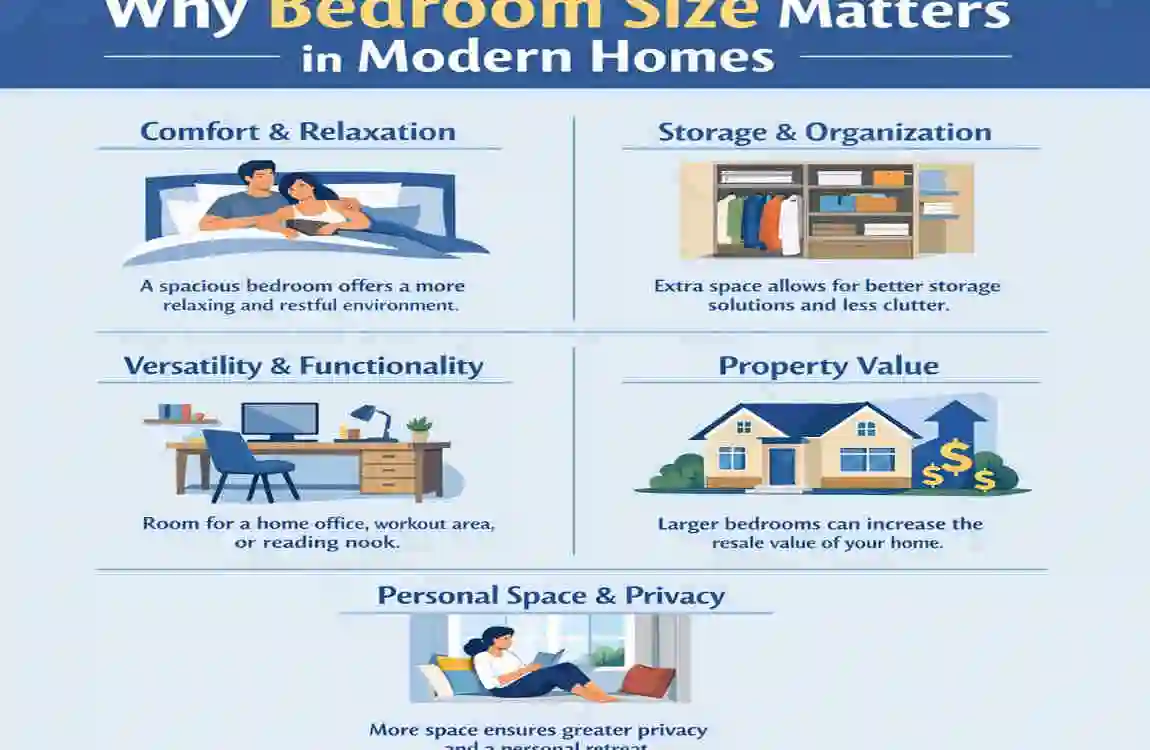
As long as a bed fits through the door, the room is perfectly fine. However, interior designers and real estate experts know that asking “how big is a bedroom?” is one of the most important questions you can ask during a build or renovation. Let’s explore exactly why these dimensions matter so much in modern houses.
The Functionality Factor
First and foremost, your bedroom needs to function smoothly. You need physical space to move around your furniture without bumping your shins. A well-proportioned room easily accommodates your essential furniture: a comfortable bed, two nightstands, and a dresser.
Furthermore, as we move through 2026, the way we use our bedrooms has drastically changed. The post-2025 landscape has made hybrid home offices incredibly popular. Many homeowners now require extra square footage in their primary bedrooms to fit a small work desk or a comfortable seating area for taking morning video calls. If your room is too small, squeezing in these modern necessities becomes a frustrating puzzle.
Impact on Sleep Quality and Feng Shui
Believe it or not, the size of your room directly affects how well you sleep at night. A cramped, cluttered space elevates stress levels and increases anxiety, making it harder for your brain to wind down.
When you have adequate space, you can practice basic Feng Shui principles. You can place your bed in the “command position,” facing the door, without being directly in line with the door. You can maintain equal walking space on both sides of the mattress, which promotes harmony and balance. A room with breathing room translates directly to a mind with breathing room.
Boosting Your Resale Value
When it comes time to sell your property, the average room size house buyers look for plays a massive role in your asking price. Real estate agents will tell you that undersized bedrooms are a major dealbreaker for potential buyers. Families want to know their teenagers will have room to grow, and couples want a main suite that feels like a private retreat. Optimal sizing automatically boosts your home’s market appeal and can significantly increase your final sale price.
Common Sizing Mistakes to Avoid
When planning a house, people often try to squeeze too many rooms into a limited floor plan. This leads to the most common architectural mistake: creating undersized rooms under 100 square feet. While technically legal in some areas, a 90-square-foot room is incredibly difficult to furnish. It often limits you to a twin bed pushed tightly against a wall, leaving zero room for a proper closet or a desk. Always prioritize the quality of the space over the sheer quantity of rooms.
Standard Bedroom Sizes by Type: How Big is a Bedroom?
Not all bedrooms are created equal, and they certainly shouldn’t be the same size. The ideal standard bedroom dimensions depend entirely on who is sleeping in the room and what they need to do there.
To give you a clear, quick reference, here is a breakdown of standard sizes you will find in typical modern homes:
Bedroom Type Min Size (sq ft)Ideal Range (sq ft)Typical Dimensions (ft)Best For
Guest / Child Room 70 sq ft 120 – 132 sq ft 10 x 12 Basic furniture + twin or full bed
Primary Bedroom 120 sq ft 132 – 200 sq ft 12 x 14 Queen bed + small seating area
Master Suite 200 sq ft 200 – 224+ sq ft 14 x 16 King bed + walk-in closet + ensuite
Let’s dive deeper into each of these specific room types so you can understand exactly how these numbers translate into real-life comfort.
The Guest or Child’s Room (120-132 Sq Ft)
When you ask a builder, “How big is a bedroom for a child or a weekend guest?” the answer usually falls right around 120 to 132 square feet. A 10-foot-by-12-foot footprint is incredibly common in American and European homes.
This size is incredibly versatile. It comfortably fits a twin or full-sized bed, a standard upright dresser, and a small standard reach-in closet. For a child, this leaves enough open floor space in the center of the room to spread out toys or set up a small homework desk. For a guest, it provides a cozy, unwinding space that feels welcoming without wasting valuable square footage in your home.
The Primary Bedroom (132-200 Sq Ft)
The primary bedroom is the main sleeping quarters for the homeowners, usually in a mid-sized family home. Stepping up to a 12-foot-by-14-foot layout gives you roughly 168 square feet to play with.
This jump in size is crucial because it lets you comfortably upgrade to a queen-sized bed. You will have plenty of room for two substantial nightstands on either side, a long horizontal dresser, and a tall chest of drawers. This size range prevents the furniture from feeling like it is closing in on you, ensuring you have clear, safe walking paths to the door and the closet in the dark.
The Main Suite (200-224+ Sq Ft)
Now we are entering the realm of true luxury. A main suite is designed to be an absolute sanctuary. Starting at 200 square feet and often expanding well past 224 square feet, these rooms are built around king-sized beds.
A standard 14-foot-by-16-foot footprint gives you an incredible 224 square feet. In a room this large, the bed becomes the grand centerpiece. You have ample room to add a plush bench at the foot of the bed, a dedicated reading nook with two armchairs, and direct access to a sprawling walk-in closet and an attached main bathroom.
- Allow 36 inches around the bed: You need at least three feet of space on the sides and foot of the bed to make walking and making the bed comfortable.
- Leave 36 inches in front of dressers: You need room to stand while pulling drawers completely open.
- Keep 24 inches for closet doors: If you have traditional swinging closet doors, ensure they do not hit your bed frame when fully opened.
Regional and Building Code Variations
You cannot just draw a tiny square on a piece of paper and call it a bedroom. The law actually has a lot to say about the size of a bedroom. Building codes exist to keep you safe, ensure proper ventilation, and help you escape in an emergency. These rules also vary wildly depending on where you live in the world.
United States Building Codes (IRC)
In the United States, most local municipalities follow the International Residential Code (IRC). The IRC states that a space must have a minimum floor area of 70 square feet to be considered a bedroom. Furthermore, it cannot be narrower than 7 feet in any horizontal direction.
You also need a ceiling height of at least 7 feet throughout most of the room. This stops people from putting a mattress in a cramped, tiny attic crawlspace and trying to sell the house as a “three-bedroom” property.
United Kingdom Standards
Across the pond in the United Kingdom, housing tends to be more compact. Still, the legal standards for minimum sizes are quite strict to prevent overcrowding. Under the Nationally Described Space Standard, a single bedroom (meant for one person) must have a floor area of at least 7.5 square meters, which translates to roughly 80 square feet. A double bedroom (meant for two people) must be at least 11.5 square meters, or about 123 square feet.
Asian and Urban Norms
If you travel to densely populated urban centers in Asia, such as Tokyo or Singapore, or even look at high-rise apartments in New York city, the definition of the average room size completely changes. In these regions, land is at an absolute Premium. It is incredibly common for master bedrooms to hover around 100 square feet. Builders in these areas rely heavily on ingenious built-in storage, sliding doors, and vertical space to make these smaller footprints feel luxurious and highly functional.
The Push for Energy-Efficient Homes
As we navigate 2026, building codes globally are placing a massive emphasis on energy efficiency. Interestingly, this is subtly impacting bedroom sizes. Massively oversized master suites require a tremendous amount of electricity and gas to heat and cool. Consequently, many modern, eco-conscious architects are scaling back slightly on square footage. They are designing perfectly optimized 150-square-foot primary bedrooms with superior insulation, focusing on high-quality materials rather than echoing, empty square footage.
Factors Influencing Bedroom Size Choices
When you are designing a new build or planning a major renovation, standard bedroom dimensions are a great starting point. However, you must tailor those numbers to your specific reality. Several distinct factors will determine exactly how big a bedroom is in your specific home.
Your Family’s Unique Needs
Who is going to live in this house? A family with three toddlers has very different needs from a retired couple. If you have young children, they will likely spend a lot of time playing on their bedroom floors, meaning a 132-square-foot room is highly beneficial.
Conversely, if you are an “empty nester” who rarely has guests, you might prefer to allocate more of your home’s square footage to a sprawling open-concept kitchen, while keeping your spare guest bedrooms closer to the 100-square-foot minimum. Always build for the life you actually live, not the life you see in a magazine.
Your Overall House Style
The architectural style of your home naturally dictates the sizes of your rooms. A cozy, single-story 1920s Craftsman bungalow was historically built with smaller, compartmentalized rooms. Trying to force a massive 224-square-foot main suite into a vintage bungalow often ruins the flow of the entire house.
On the other hand, a sprawling, modern two-story suburban home demands larger proportions. A tiny 100-square-foot primary bedroom inside a massive 3,500-square-foot house will feel entirely out of place and disproportionate. Your bedroom size should always scale naturally with your home’s total footprint.
Budget and Cost Per Square Foot
Let’s talk about your wallet. Every single square foot you add to a floor plan costs money in lumber, drywall, flooring, roofing, and labor. In 2026, the average cost to build or add onto a home ranges heavily from $150 to over $300 per square foot, depending on your local market and finishes.
Adding just 2 feet to the width and length of a bedroom (going from 10×12 to 12×14) adds 48 square feet. At $200 a square foot, that is an extra $9,600 just for a little more walking space! You must balance your desire for a sprawling main suite with your realistic construction budget.
Renovation Hacks for Small Spaces
What if you are stuck with a smaller footprint and cannot afford to push the walls out? Do not panic. You can make a 100-square-foot bedroom feel incredibly spacious with a few clever renovation hacks:
- Install Pocket Doors: Traditional swinging doors eat up nearly 10 square feet of usable floor space. Sliding pocket doors vanish into the wall, giving you that space back.
- Use Vertical Storage: Build custom shelving that extends to the ceiling to draw the eye upward and free up valuable floor space.
- Consider a Murphy Bed: For a guest room/home office hybrid, a bed that folds flat against the wall gives you ultimate daytime flexibility.
- Maximize Natural Light: Installing larger windows or skylights makes any small room feel instantly expansive and airy.
How to Measure and plan Your Bedroom Layout
Knowing the average room size of a house is helpful, but how do you actually visualize it in your own space? Whether you are buying a new bed or knocking down a wall, you must know how to measure and plan your layout properly. Grab a tape measure, some graph paper, and a pencil, and let’s get to work.
Sketch Your Floor plan
Start by measuring the absolute maximum length and width of your room from baseboard to baseboard. Transfer these measurements onto your graph paper. A great rule of thumb is to let one square on the paper equal one foot of real space.
Draw the solid walls first. Then, mark exactly where the doorways and closets are located. This is your blank canvas. Seeing the room’s shape on paper helps you understand whether you have a perfectly square room or a challenging rectangular space.
Factor in Egress Windows and Doors
This is a crucial step that many homeowners forget! You cannot put a piece of furniture in front of a door, and you absolutely should not block your windows.
Building codes dictate that every legal bedroom must have an “egress” window—a window large enough for a person to escape through during a fire, and for a firefighter wearing full gear to climb into. The IRC requires this window to have a minimum clear opening of 5.7 square feet. When you are planning your room layout, you must leave a clear, unobstructed path to this emergency exit. Do not place a heavy, immovable dresser right in front of your only escape route.
Test Your Furniture Layouts
Now comes the fun part. Cut out small pieces of paper to represent your bed, dressers, and nightstands (keeping them to the same scale as your graph paper room).
Move these paper furniture pieces around your sketched room. Start by placing the largest item first: the bed. The bed usually dictates the flow of the entire room. Place it on the longest unbroken wall.
Once the bed is placed, move your dressers and nightstands into the remaining spaces. This is where you test those golden clearance rules we discussed earlier. Do you have 36 inches to walk around the bed? Can you open your closet door fully? By testing layouts on paper first, you save yourself the back-breaking labor of moving a heavy mattress across the room five different times.
Real Home Examples and Case Studies
To really understand how big a bedroom is in practice, it helps to look at what homeowners and architects are actually building right now. The year 2026 has brought us two very distinct, polarized trends in residential architecture. Let’s look at how bedroom size plays a role in both extremes.
The Tiny Home Movement (Under 132 Sq Ft)
The minimalist lifestyle continues to surge in popularity, leading to a massive boom in Tiny Homes and Accessory Dwelling Units (ADUs). In these micro-homes, standard bedroom dimensions are thrown completely out the window.
We recently reviewed a beautiful eco-cabin where the primary “bedroom” was exactly 72 square feet—just two square feet over the legal minimum. To make this work, the architects elevated the queen-sized bed on a custom-built wooden platform. Underneath the platform were deep, pull-out storage drawers that eliminated the need for a dresser. By painting the walls a crisp white and installing a massive skylight directly over the bed, this tiny footprint felt like a cozy, romantic nest rather than a cramped box. It proves that with brilliant design, you do not need 200 square feet to be perfectly comfortable.
The Luxury Estate Trend (224+ Sq Ft)
On the complete opposite end of the spectrum is the luxury estate trend, where the main suite is treated as a self-contained apartment within the house.
In a recent 2026 suburban build case study, the architects dedicated an astonishing 400 square feet solely to the primary sleeping quarters. This massive 20-foot by 20-foot room easily swallowed a California King bed. The extra square footage allowed the homeowners to build a stunning stone fireplace directly across from the bed, flanked by two oversized reading couches. The room featured French doors opening out to a private balcony. In this scenario, the bedroom size transformed the space from a mere place to sleep into a private, luxurious weekend getaway.
FAQs: Quick Answers on Bedroom Sizes
Still have a few lingering questions about room dimensions? You are not alone! Here are the quick, definitive answers to the most common questions homeowners ask about standard bedroom size in a house.
How big is a bedroom, minimum?
Under United States law (the International Residential Code), a room must have a minimum floor area of 70 square feet to be officially designated a bedroom. Furthermore, it cannot be narrower than 7 feet in any direction, meaning a 5×14-foot hallway cannot legally house a bed.
What is the average main bedroom size?
In a standard, modern, single-family home in 2026, the average main bedroom size sits right around 200 to 224 square feet. This typical 14×16 foot layout provides the perfect balance, offering enough room for a king-sized bed and walking space without feeling overly cavernous.
Is 132 sq ft enough for a bedroom?
Yes, absolutely! A 132-square-foot room (typically measuring 11×12 or 10×13 feet) is an excellent, highly functional size for most people. It easily holds a queen-sized bed, a dresser, and two nightstands while maintaining comfortable walking paths. It is the perfect sweet spot for guest rooms, teenagers’ rooms, or a comfortable primary bedroom in a smaller home.
