
Ever stood in an empty room and wondered, “Is this actually a normal bedroom size?” You are not alone. Whether you are building a house, shopping for a home, remodeling a room, or simply trying to fit a larger bed, understanding the standard bedroom size in square footage can save you time, money, and frustration.
Smaller bedrooms may start at 70 square feet, which is often the legal minimum in many places. On the other end, a comfortable primary or master bedroom can range from 130 to 200+ square feet. At the same time, luxury homes can go much larger.
That sounds straightforward, but real life is a little more complicated. A bedroom that looks fine on paper may still feel cramped if the bed is too large, the layout is awkward, or the closet eats up usable space. That is why knowing the average bedroom dimensions, minimum bedroom size, and practical layout rules matters so much.
What Is a Standard Bedroom Size Square Footage?
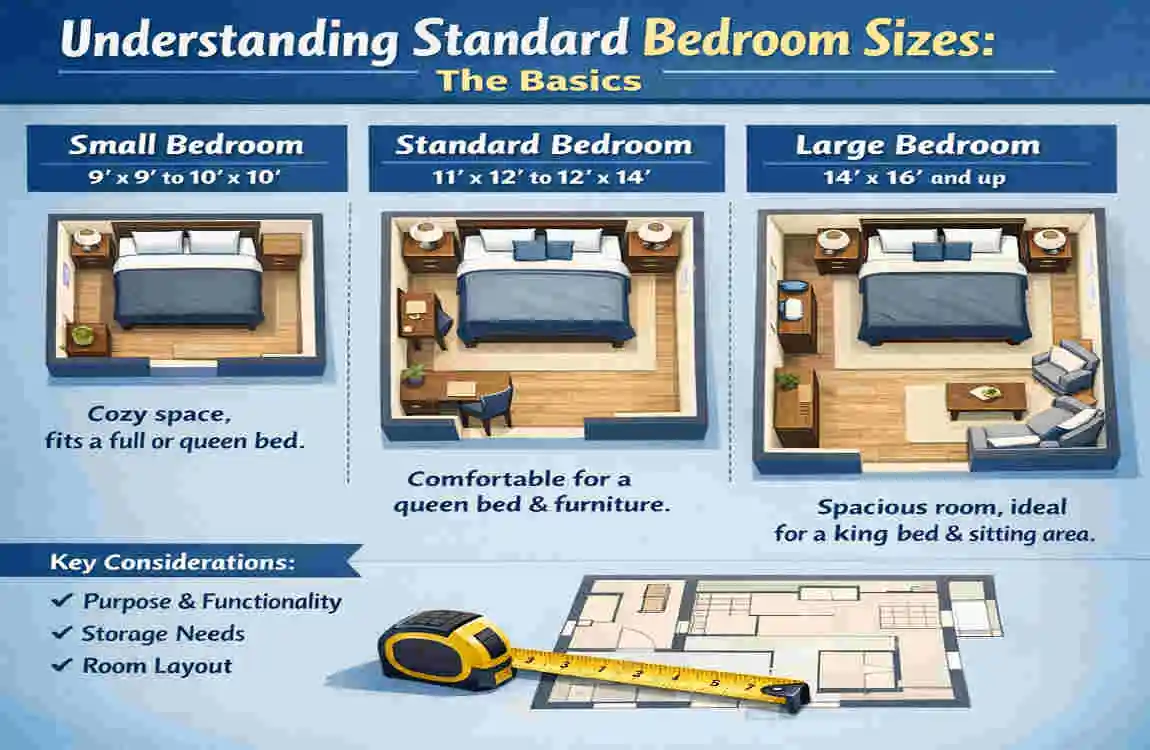
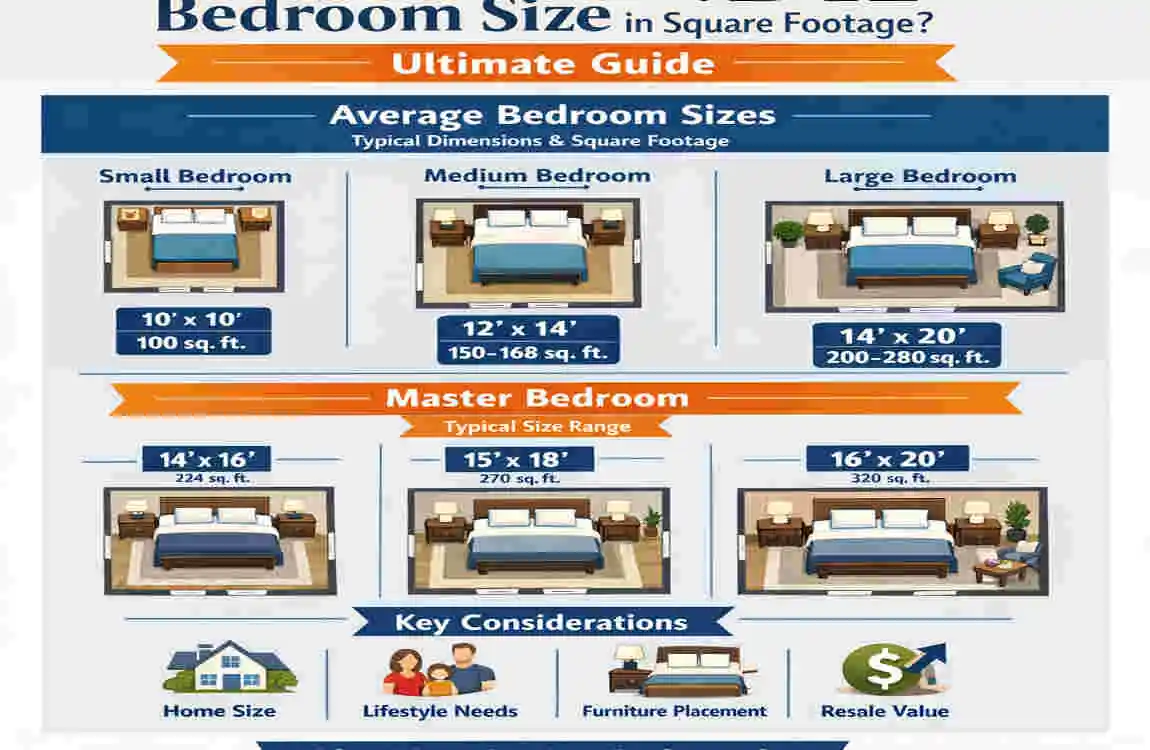
When people ask what the standard bedroom size is in square footage, they usually want one clear number. In most homes, the most common answer is: around 100 to 150 square feet for a regular bedroom and 130 to 200 square feet for a primary bedroom.
That means many standard bedrooms are built in sizes like:
- 10 x 10 feet = 100 square feet
- 10 x 12 feet = 120 square feet
- 11 x 12 feet = 132 square feet
- 12 x 12 feet = 144 square feet
These sizes are common because they are practical. They allow enough room for a bed, basic furniture, and walking space without making the room feel oversized or wasteful.
Why bedroom square footage matters
Bedroom size affects more than comfort. It can influence:
- Furniture choices
- Storage options
- Home resale value
- Appraisal expectations
- Building code compliance
- How livable the room feels day to day
A 100-square-foot room may work well as a child’s room, guest room, or office-bedroom combo. But if you want a king bed, dresser, lounge chair, and generous walkway space, you will likely need more.
Standard dimensions people see most often
Square footage tells you the total floor area, but dimensions tell you how that space actually works. Two rooms that are both 120 square feet can feel very different.
For example:
- A 10 x 12 room often feels balanced and easy to furnish.
- An 8 x 15 room has the same square footage, but the narrow shape can limit layout options.
That is why the standard bedroom size in square footage should always be considered alongside room shape, door placement, window placement, and closet space.
What experts and housing guidelines generally suggest
In the U.S., many builders, designers, and housing professionals treat 10 x 10 feet as the practical minimum for a usable standard bedroom, even though some local codes allow smaller sizes. A 12 x 12 bedroom is often seen as a more comfortable average size for secondary bedrooms.
For primary bedrooms, 14 x 14 feet is often considered ideal because it gives you more freedom with larger beds and extra furniture.
Minimum vs. Average vs. Ideal Bedroom Sizes
Understanding the difference between minimum, average, and ideal bedroom sizes helps you set realistic expectations.
A room can meet legal standards but still feel tight. Another room can feel roomy and comfortable even if it is not especially large. The key is knowing what each size level is meant for.
Quick bedroom size comparison table
Bedroom Type Square Footage Dimensions (ft)Best For
Minimum 70 sq ft 7 x 10 Small guest room, nursery, compact bedroom
Small Standard 100 sq ft 10 x 10 Basic bedroom, twin/full bed setup
Average 120 sq ft 10 x 12 Secondary bedroom, guest room, kid’s room
Comfortable 144 sq ft 12 x 12 Queen bed, better circulation, extra storage
Ideal Primary 196 sq ft 14 x 14 Master/primary bedroom with more furniture
Spacious Luxury 225+ sq ft 15 x 15 or larger Large primary suite, seating area, premium layout
Minimum bedroom size
In many parts of the U.S., the minimum bedroom size is 70 square feet, and one wall often must measure at least 7 feet long. This comes from widely adopted residential code standards.
A 70-square-foot bedroom is legal in many cases, but that does not mean it is spacious. In fact, it often works best for:
- A nursery
- A small child’s room
- A compact guest room
- A bedroom with minimal furniture
Average bedroom size
The average bedroom dimensions in many homes fall close to 10 x 12 feet, or 120 square feet. This is a very common size because it fits well into daily life.
A room around 120 square feet can usually handle:
- A twin, full, or queen bed
- One or two nightstands
- A dresser
- Reasonable walking space
This is why many people consider this the true “standard” bedroom size.
Ideal bedroom size
An ideal bedroom depends on your goals, but many homeowners prefer at least 140 to 200 square feet for comfortable long-term use. This range works well when you want:
- A queen or king bed
- More storage
- Better traffic flow
- A small desk or chair
- Extra flexibility for future changes
If you plan to stay in your home for years, thinking beyond the bare minimum often pays off.
What affects the right size?
There is no perfect size for every person. The best bedroom size depends on:
- Bed size
- Who uses the room
- Closet size
- Furniture amount
- Room shape
- Window and door placement
- Personal comfort preferences
So, when asking what the standard bedroom size is in square footage, remember that the answer is both numerical and practical.
Standard Master Bedroom Size Square Footage
A standard main bedroom’s square footage is usually larger than that of a secondary bedroom. Today, many people also use the term primary bedroom, but the size expectations are similar.
In most homes, a standard primary bedroom ranges from 130 to 200 square feet, while more upscale homes often go beyond that.
Typical primary bedroom dimensions
Common primary bedroom sizes include:
- 12 x 12 feet = 144 square feet
- 12 x 14 feet = 168 square feet
- 14 x 14 feet = 196 square feet
- 15 x 15 feet = 225 square feet
These dimensions give the room more flexibility, especially if the bedroom includes a sitting area, a larger closet, or an ensuite bathroom.
Why primary bedrooms are usually larger
A primary bedroom often needs to fit more than just a bed. It may also include:
- A king or queen bed
- Two nightstands
- A dresser or chest
- A bench at the foot of the bed
- A chair or reading nook
- Better walking space
- Access to a bathroom or walk-in closet
That is why master bedroom square footage is generally higher than that of other bedrooms.
How much space feels comfortable?
For many homeowners, 14 x 14 feet feels like a sweet spot. It allows a king bed without making the room feel crowded. You can also add a dresser or chair and still move around comfortably.
If the room is under 130 square feet, it may still work as a primary bedroom, but furniture planning becomes more important. You might need slimmer nightstands, wall-mounted lighting, or storage that doubles as décor.
What about luxury primary bedrooms?
In luxury homes, primary bedrooms often start at 250 square feet and go much larger. These rooms may include:
- Lounge seating
- Fireplaces
- Built-in wardrobes
- Private balconies
- Work-from-home corners
- Smart lighting and media walls
These are not standard sizes, but they show how far bedroom expectations can stretch at the high end of the market.
Guest and Kids’ Bedroom Sizes
Not every bedroom needs to be as large as the primary suite. In fact, guest rooms and kids’ bedrooms often work very well in smaller footprints.
Standard guest bedroom size
A standard guest bedroom typically measures 100 to 120 square feet. This size usually accommodates a queen or full bed, a nightstand, and a small dresser without much trouble.
A guest room does not need to hold everyday clutter the way a primary bedroom does. Since it is used less often, you can keep the layout simpler and cleaner.
A good guest room size might be:
- 10 x 10 feet
- 10 x 11 feet
- 10 x 12 feet
If you want the room to feel more welcoming, aim for at least 120 square feet.
Standard kids’ bedroom size
A kids’ bedroom often ranges from 80 to 120 square feet. For a younger child, a smaller room may work just fine. But if you want the room to grow with them, going a little larger makes life easier later.
Children’s rooms often need space for:
- A bed
- A dresser
- Toys or bins
- A study desk
- Open floor area for play
That is why many families prefer sizes closer to 10 x 11 or 10 x 12 feet rather than the legal minimum.
Layout tips for guest and children’s rooms
Here are a few practical guidelines that help these rooms work better:
- A twin bed usually fits well in a 9 x 10-foot room
- A full bed works better in a 10 x 10-foot room or larger
- A queen bed is most comfortable in a room at least 10 x 10 feet
- Leave enough space to open drawers and closet doors fully
- Keep at least 24 to 36 inches of walking space around key furniture
These little details matter more than people think. A bedroom may have decent square footage, but if every walkway feels blocked, the room still feels cramped.
Planning for the future
If you are designing a home, try to future-proof smaller bedrooms. A nursery may later become a school-age child’s room, then a teen’s room, then a guest bedroom or office.
That is why many homeowners prefer to build secondary bedrooms around 100 to 120 square feet rather than stopping at the minimum allowed size.
Standard Bedroom Size for Queen Bed
One of the most common questions about standard bedroom size square footage is: How big should a room be for a queen bed?
A queen bed measures about 60 x 80 inches, so it needs a room with both floor and circulation space.
A minimum room size for a queen bed is usually around 10 x 10 feet, or 100 square feet. But that setup can feel tight, especially if you want nightstands or a dresser.
A more comfortable size is 10 x 12 feet or larger. This gives you room to move around and makes the room feel more balanced.
Standard Bedroom Size for King Bed
A king bed is much larger, measuring about 76 x 80 inches. Because of that, a king bed usually needs at least 12 x 12 feet (144 square feet) to fit comfortably.
If you want nightstands on both sides and a dresser across from the bed, 12 x 14 feet or more.
A king bed in a small room can quickly overwhelm the layout. So if you are choosing between a bigger bed and easier movement, comfort often comes from better flow, not just bigger furniture.
Building Codes and Legal Minimum Bedroom Sizes
If you are renovating, selling, or converting a room into a bedroom, code rules matter. A room may look like a bedroom, but that does not always make it a legal bedroom.
Common U.S. code expectations
In many places that follow versions of the International Residential Code (IRC), a bedroom generally must meet these standards:
- At least 70 square feet
- At least 7 feet in one horizontal direction
- A ceiling height that meets local code
- A proper emergency egress window or door
- Heating and ventilation requirements, depending on local rules
Buyers often expect a closet, but many places do not require one for a room to be legally considered a bedroom. Local rules vary, so always check with your city or county.
Why the egress window matters
The window is not just for light. It is also a safety requirement. In many jurisdictions, a legal bedroom must have a window or door large enough for emergency escape and rescue access.
That means if you are converting a basement, attic, or den into a bedroom, the room may need upgrades before it can be marketed legally as one.
State and local differences
Local code can differ from one place to another. Some cities and states are stricter. Others are more flexible. You may see differences in:
- Minimum ceiling height
- Window size requirements
- Basement bedroom rules
- Heating and cooling standards
- Definition of habitable space
So while 70 square feet is a common baseline, it is not the whole story.
International bedroom size guidelines
Outside the U.S., bedroom size standards can look different.
In the UK, small single bedrooms are often discussed in square meters rather than square feet. A commonly referenced minimum is around 6.5 square meters per person, and larger minimums apply to two-person rooms. That equals roughly 70 square feet, not 753.
Across parts of Europe, room sizes vary widely depending on city density, building age, and apartment design. In many urban areas, bedrooms tend to be smaller than in typical U.S. suburban homes.
How Square Footage Affects Home Value
Bedroom size does not affect value in the same way everywhere, but it absolutely plays a role.
Real estate buyers do not only count the number of bedrooms. They also care about whether those bedrooms are usable, comfortable, and appropriately sized.
Why size influences buyer perception
A home listed as having four bedrooms sounds attractive. But if one of those rooms barely fits a twin bed, buyers may see it as an office or flex room instead.
Larger, well-proportioned bedrooms often help a home feel more functional. That can support:
- Better buyer interest
- Stronger listing photos
- Improved appraisal appeal
- Greater day-to-day livability
The value of usable space
In real estate, usable square footage matters more than wasted square footage. A poorly laid-out bedroom can feel smaller than it is. On the other hand, a smart 120-square-foot room can feel generous.
That is why buyers often respond best to bedrooms that offer:
- Good natural light
- Practical wall space
- Adequate circulation
- Space for normal furniture sizes
Bedroom count vs. bedroom quality
It is tempting to think more bedrooms automatically mean higher value. But quality matters too. Three well-sized bedrooms may appeal more than four tiny ones.
If you are renovating, ask yourself:
- Will this room function well as a true bedroom?
- Can it fit a bed and still feel comfortable?
- Does it meet legal code?
- Will buyers see it as useful space?
Bed Size, Furniture, and Layout Impact
The best way to understand standard bedroom size in square footage is to think about what must actually fit inside the room.
A bedroom is not just an empty box. It needs to support sleeping, storage, movement, and comfort.
How much space does a bed use?
Beds often take up 30% to 40% or more of a bedroom’s floor area, depending on room size.
Here is a simple way to think about it:
- In a 100-square-foot room, a queen bed can dominate the layout
- In a 144-square-foot room, the same bed feels much more manageable
- In a 196-square-foot room, you have room for extra furniture and better flow
Recommended clearance around furniture
Interior designers often suggest keeping about 24 to 36 inches of walking space around major furniture pieces where possible. That includes:
- Sides of the bed
- Foot of the bed
- Path to the closet
- Path to the door
- Space in front of dressers
This “breathing room” makes a bedroom feel comfortable. Without it, even a room with decent square footage can feel tight.
Simple bedroom size formula
A useful planning formula is:
Total Sq Ft = Bed Area + 30% Circulation Space + Storage/Closet Zone
This is not a legal rule, but it is a helpful design shortcut.
For example, if your bed and basic furniture use about 70 square feet, and circulation plus storage needs another 30 to 50 square feet, you can quickly see why a room under 100 square feet starts to feel limited.
Think beyond the bed
When planning a bedroom, also account for:
- Nightstands
- Dressers
- Desk or vanity
- Reading chair
- Built-in wardrobe
- Door swing
- Window access
- Outlet placement
A room’s usability depends on all of these pieces working together.
Modern Trends in Bedroom Sizing
Bedroom design has changed a lot in recent years. People now use bedrooms for more than sleeping. They may read, work, exercise, or retreat there for quiet time.
That shift affects how people think about average bedroom dimensions.
Tiny home bedrooms
Tiny homes and compact urban apartments have pushed bedroom sizes to smaller sizes. In these spaces, bedrooms may be only 50 to 80 square feet.
These rooms often rely on:
- Loft beds
- Murphy beds
- Built-in storage
- Fold-down desks
- Sliding doors
In small-space living, smart design matters more than raw square footage.
Multi-functional bedrooms
Many people now want bedrooms that can serve two purposes. A guest room may also be a home office. A child’s room may include study space. A primary bedroom may include a reading nook or exercise corner.
Because of this, a room that once felt large enough may now feel too small.
Luxury bedroom trends
At the higher end of the market, bedrooms continue to grow in size. Luxury primary bedrooms often exceed 250 to 300 square feet and may include features like:
- Sitting areas
- Accent walls
- Smart climate control
- Hidden lighting
- Walk-in dressing zones
- Spa-like bathroom connections
Sustainable and space-smart design
Not every homeowner wants bigger rooms. Some prefer efficient rooms that use space well. This is where sustainable design and practical planning come together.
Popular ideas include:
- Built-in wardrobes instead of bulky furniture
- Wall-mounted shelves
- Under-bed storage
- Multi-use benches
- Murphy beds
- Light-reflecting color palettes
The trend today is not only about size. It is about how well the bedroom works.
How to Measure Your Bedroom Square Footage Accurately
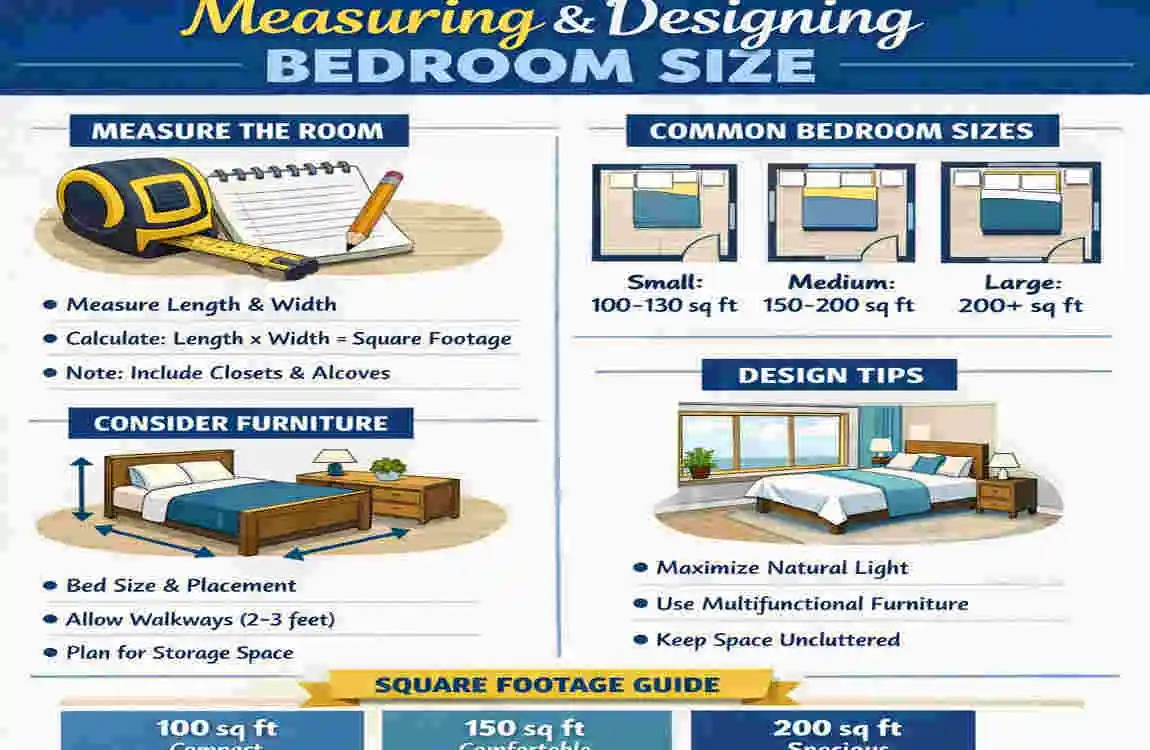
If you want to know whether your room meets a standard size, start by measuring it correctly.
The good news is that bedroom square footage is easy to calculate.
Step-by-step measuring process
- Clear the space as much as possible
- Move lightweight furniture if needed so you can access the walls.
- Measure the room length
- Use a tape measure or a laser measurer to measure from one wall to the opposite wall.
- Measure the room width
- Measure the shorter direction the same way.
- Multiply length by width
- Example: 10 feet × 12 feet = 120 square feet
- Handle unusual shapes separately
- If the room has a nook or cutout, divide it into rectangles, measure each section, and add them together.
- Check whether closet space is counted
- In some listings, closet area may be included in room dimensions. In others, it may not be. Be clear about which method you are using.
Best tools for measuring
You can measure a bedroom with basic tools, but some tools make the process easier:
- Tape measure
- Laser distance measurer
- Notepad or phone notes
- Sketch app or graph paper
A laser measurer is especially helpful for larger rooms or awkward layouts.
Affiliate link opportunity: Add a product link to a laser room measurer or measuring tape set.
Common measuring mistakes
Avoid these common errors:
- Measuring baseboard to baseboard instead of wall to wall
- Forgetting alcoves or small offsets
- Guessing rather than measuring
- Ignoring sloped ceilings in attics
- Assuming listing dimensions are always accurate
If you are buying a home, always verify dimensions yourself when room size matters.
Design Hacks for Small Bedrooms
A small bedroom does not have to feel cramped. With the right strategy, even a room near the lower end of the standard bedroom-size square footage can feel stylish and functional.
Smart ways to make a small bedroom feel bigger
Here are some design tricks that work especially well:
- Use vertical storage with tall shelves or wall cabinets
- Choose light wall colors to reflect natural light
- Use multi-purpose furniture like storage beds or benches
- Install wall sconces instead of table lamps
- Use mirrors to create visual depth
- Pick furniture with visible legs to keep the room airy
- Reduce clutter and keep surfaces clean
- Use sliding closet doors if possible to save swing space
Layout matters more than decoration
Before buying décor, focus on the furniture arrangement. A better layout can instantly make a room feel larger.
Try placing the bed against the strongest wall and keeping the path from the door to the window as open as possible. If the room is narrow, avoid oversized dressers that block movement.
Storage should work hard
In a small bedroom, every item should earn its place. That means using:
- Under-bed bins
- Headboards with storage
- Floating shelves
- Narrow nightstands
- Closet organizers
Debunking Bedroom Size Myths
There are many myths about bedroom sizing that can confuse homeowners quickly.
All bedrooms must be 120 square feet
This is false. Many legal bedrooms are smaller. In many areas, the minimum is 70 square feet, though local code may vary.
Bigger is always better
Not necessarily. A poorly laid-out 180-square-foot room can feel less comfortable than a well-planned 120-square-foot room.
A room is a bedroom only if it has a closet
This depends on local practice and market expectations. In many places, a closet is common and preferred, but not always legally required.
Square footage alone tells you everything
It does not. Shape, storage, windows, and circulation can completely change how a room feels.
The truth is simple: the best bedroom size is the one that matches your needs and functions well in daily life.
Bedroom Size FAQs
Below are some quick, schema-friendly answers to common questions about what a standard bedroom size is and how to calculate square footage.
What is a standard bedroom size square footage in the US?
A standard bedroom in the U.S. is typically 100 to 150 square feet, while a primary bedroom is often 130 to 200 square feet. Many secondary bedrooms are about 10 x 12 feet, or 120 square feet.
Is 100 square feet enough for a bedroom?
Yes, 100 square feet is enough for a bedroom in many cases. It can usually fit a twin, full, or even a queen bed, though a queen setup may feel tight depending on other furniture.
What is the average main bedroom square footage?
The average main bedroom square footage often falls between 140 and 200 square feet, with 14 x 14 feet being a very comfortable size.
What is the minimum legal bedroom size?
In many places that use common U.S. residential code standards, the minimum bedroom size is 70 square feet, with a minimum of 7 feet in one direction. Local code may require more.
What size bedroom fits a queen bed?
A queen bed fits best in a room that is at least 10 x 10 feet, though 10 x 12 feet or larger is usually more comfortable.
What size bedroom fits a king bed?
A king bed usually needs at least 12 x 12 feet, and 12 x 14 feet is often better if you want extra furniture and more walking space.
