
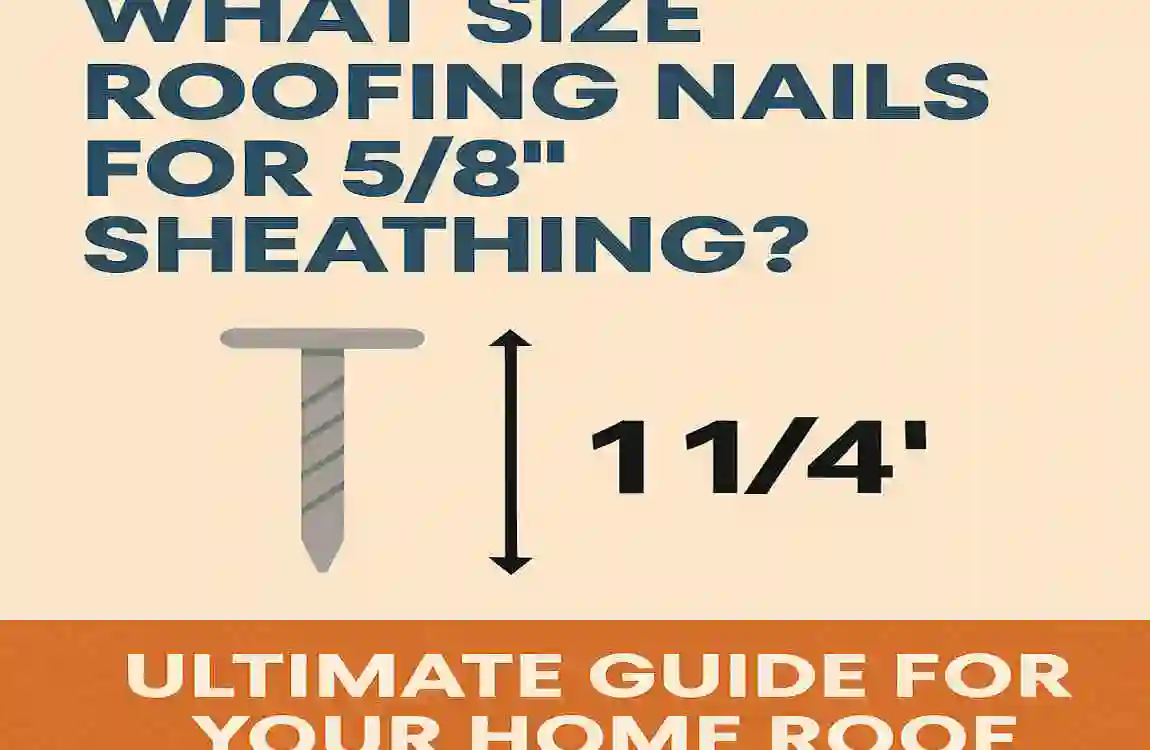
What size roofing nails for 5/8 sheathing? Choosing the wrong ones can lead to leaks, structural failures, or even failed building inspections. Imagine putting in all that hard work on your roof, only to have it buckle under the first strong wind because your nails didn’t hold up. It’s a nightmare scenario that no homeowner or contractor wants to face.
Nail Size Recommendations

When it comes to roof sheathing nails, size matters; you want nails that penetrate deeply enough to grip the framing without being too short or too long. For 5/8-inch sheathing, the sweet spot ensures at least 1 inch of penetration into the rafters or trusses. This keeps everything secure and meets most building codes.
Let’s talk about the primary recommendation. Most experts point to 8d common nails as the go-to choice. These are 2-1/2 inches long and 0.131 inches in diameter. Why? They provide that essential 1-inch penetration after going through the 5/8-inch plywood or OSB sheathing. According to the International Residential Code (IRC) R905.2.1, this setup is ideal for standard installations.
But don’t just take my word for it—let’s compare some options. You might wonder if a shorter nail could work in a pinch. A 6d nail, which is only 2 inches long, falls short. It might give you just 1-3/8 inches of total length after sheathing, but that’s not enough for a solid hold in many cases. It could lead to pull-out issues during high winds.
On the flip side, an 8d nail is the ideal minimum size. It’s reliable for most residential roofs. If you’re in a high-wind area or dealing with thicker setups, step up to a 10d nail at 3 inches long. This gives extra penetration, like 1-3/8 inches into the framing, adding that layer of security.
See how the 8d stands out for 5/8-inch? It’s all about balance. Using the right size prevents issues like sheathing uplift, which can cause shingles to fly off or water to seep in. Have you ever dealt with a roof repair gone wrong? Choosing based on this table can save you headaches.
Of course, these aren’t one-size-fits-all. Factors like your local climate or roof pitch influence your pick. For instance, in snowy regions, heavier loads call for longer nails. We’ll touch on codes next, which tie directly into this.
Remember, nail length for OSB isn’t much different from plywood—both benefit from that 1-inch minimum penetration. If you’re unsure, measure the thickness of your sheathing first. It’s a simple step that pays off big time.
Building Code Requirements
Building codes might sound boring, but they’re your best friend for a safe roof. They set the standards to ensure your home withstands the weather and the test of time. For roofing code requirements, the International Residential Code (IRC) and the International Building Code (IBC) are the key references.
Let’s break it down. The IRC specifies that for sheathing attachment, you need 8d nails that are 2-1/2 inches long and 0.131 inches in diameter. Spacing is crucial too: 6 inches on center at the edges and 12 inches in the field. This pattern distributes the load evenly and prevents weak spots.
But codes aren’t uniform everywhere. Local variations kick in, especially in hurricane-prone zones. There, you might need ring shank nails for better grip, or even more extended sizes like 10d. It’s all about enhancing wind resistance. Check your area’s requirements—don’t assume one code fits all.
Material matters as well. Codes often require galvanized or stainless steel nails to fight corrosion. Rust can weaken your roof over time, leading to costly fixes. Imagine nails deteriorating in a humid climate; that’s a recipe for disaster.
Why do these rules exist? They protect you and your property. Proper adherence means your roof can withstand uplift forces from winds up to a certain speed. For 5/8-inch sheathing, sticking to IRC R905.2.1 ensures compliance.
Have you ever had an inspection fail? It’s frustrating and expensive. By following these guidelines, you avoid that. Always consult a local building official if you’re in a unique area, like coastal regions, where salt air accelerates rust.
In summary, codes blend safety with practicality. They guide you toward nails that not only fit but perform under pressure. Next, we’ll explore the different types of nails that meet these requirements.
Nail Types and Features
Not all nails are created equal. When selecting roof sheathing nails, the type and features can make a massive difference in performance. Let’s dive into the options so you can pick what’s best for your project.
First up: Ring shank nails. These have ridges along the shank that grip like claws. They’re excellent for reducing pull-out, especially with asphalt shingles over sheathing. If you’re in a windy area, ring shanks are your ally—they hold tight when smooth ones might slip.
Contrast that with smooth shank nails. They’re the budget-friendly choice, easy to drive in, but they offer less hold. In calm, dry climates, they might suffice, but don’t rely on them for high-stress roofs.
Then there’s the diamond tip feature. These pointed ends make driving easier, reducing splitting in wood. It’s a small detail that saves time and frustration during installation.
Head styles vary too. For sheathing, go for large flat heads or deformed ones—they provide a better bearing surface. If you’re nailing underlayment, plastic cap heads prevent tears.
Shank diameter is another key. Aim for 11-12 gauge; it’s strong enough without being overkill. Thinner gauges might bend, while thicker ones are harder to drive..
Installation Best Practices
Installing roofing nails isn’t rocket science, but doing it right prevents big problems. Follow these steps for a secure 5/8-inch sheathing setup.
Start by aligning your sheathing panels. Leave minimal gaps—about 1/8 inch—so the material can expand. Secure them to the rafters or trusses evenly.
Next, position your nails. Place them 3 inches from the edges with 6-inch spacing along the perimeter. In the field, space them 12 inches apart. This grid pattern ensures uniform hold.
Use a pneumatic nailer for efficiency. Set it to 70-90 PSI to drive nails without overdoing it. Hand nailing works for small jobs, but power tools speed things up.
Avoid overdriving—nails should be flush or slightly countersunk. Too deep, and you weaken the sheathing; too proud, and they snag shingles.
Pro tip: For 5/8-inch sheathing, test pull-out strength on a scrap piece. Pull a nail and see if it holds firm. This quick check confirms your setup.
Common errors? Using undersized nails leads to uplift failure. Skipping spacing rules creates weak zones. Always double-check your work.
Weather plays a role, too. Install on dry days to avoid swelling wood. And wear safety gear—gloves and goggles are musts.
By following these practices, your roof stays in good condition. It’s about precision and care—take your time, and the results will show.
Tools and Materials Needed
Gearing up for a roofing job? Having the right tools and materials makes all the difference. Let’s list out the essentials for nailing 5/8-inch sheathing.
First, a nail gun compatible with 8d coils. Pneumatic models are popular for their speed and power.
You’ll need a compressor and hose to power that gun. Look for one with at least 2-4 CFM for steady performance.
Safety gear is non-negotiable: Hard hat, safety glasses, gloves, and sturdy boots protect you on the job.
For materials, stock up on galvanized 8d nails— a 5000-count box covers most roofs. Add sheathing panels, underlayment, and flashing as needed.
Budget-wise, expect $50-100 for a DIY setup. Pros might invest more in high-end tools.
Don’t forget extras like a hammer for adjustments and a ladder for access.
With these in hand, you’re set. Prep your toolkit, and installation becomes a breeze.
Cost Comparison

Nails might seem inexpensive, but choosing wisely affects your budget and the quality of your roof. Let’s compare types for 5/8-inch sheathing.
Smooth 8d nails are the cheapest, ranging from $0.10 to $0.20 per pound. They offer medium durability and are best for dry climates.
Ring shank 8d nails cost $0.20-0.35 per pound but provide high durability. Ideal for wet or windy areas.
Stainless 8d nails run $0.50-1.00 per pound, with Premium corrosion resistance for coastal homes.
Factor in 10-20% extra for waste—nails bend or get lost.
Nail Type (per lb)Price RangeDurability RatingBest For
